

Key Takeaways
- The Fang are Equatorial Guinea's largest ethnic group. The Fang people inhabit mainland Equatorial Guinea (Río Muni) and maintain some of the country's richest ceremonial dance traditions.
- Abira is a Bubi ceremony, not a Fang tradition. Abira is a ritual practiced by the Bubi people of Bioko Island, intended to cleanse the community of evil — it is distinct from Fang cultural heritage.

Welcome to United Tribes
Where Equatorial Guinean Culture Comes Alive
Join Your Tribe
Connect with your people
Discover Events
Watch parties & festivals
Find Equatorial Guinean Businesses
Restaurants, markets & more
Earn Crown Credits
Get rewarded for engaging
- Ivanga is a key Fang ceremonial dance. Characterized by energetic footwork, natural-material costumes, and expressive gestures, ivanga appears in initiations, celebrations, and community festivals.
- Byeri and Bwiti are foundational Fang ritual practices. These religious and initiation-based dance traditions connect the Fang to ancestral knowledge and spiritual belief systems.
- Traditional Fang performance faces pressure from modernization. Globalization and cultural shifts threaten the continuity of ceremonies like ivanga and Bwiti, making documentation and community transmission increasingly vital.
Equatorial Guinea is a small but culturally layered nation — the only Spanish-speaking country in Africa — whose ethnic communities have cultivated distinct performance traditions over centuries. Understanding those traditions requires clarity and care, because the country's diversity means that one group's ceremonies are not another's. Among the Fang people of the mainland, the dance heritage is vivid and ceremonially rich, and it deserves to be explored on its own terms.
What is the traditional dance heritage of the Fang people?
The Fang people of Equatorial Guinea's mainland region, Río Muni, have a ceremonial dance tradition rooted in ancestral religion, community ritual, and collective identity—with ivanga, Byeri, and Bwiti as its most significant expressions. These are not casual entertainment performances; they are structured, spiritually grounded practices that have carried Fang cultural knowledge across generations.
It is worth addressing a common point of confusion directly. The term abira refers to a traditional purification ceremony associated with the Bubi ethnic group of Bioko Island, practiced to cleanse a community of evil and misfortune. It is not a Fang tradition. The Fang and the Bubi are distinct peoples with separate languages, histories, and ceremonial practices, and treating their traditions as interchangeable would misrepresent both cultures. This article focuses on the Fang people's authentic dance heritage.
The Fang have historically organized communal life around the abaá, a gathering space sometimes called the "house of the word," where deliberation, storytelling, and ceremony intersect. Dance within the abaá is not separate from governance or spirituality—it is woven into both. To understand Fang dance is to understand how the Fang community functions as a whole.
Ivanga Connects Celebration and Ceremonial Life
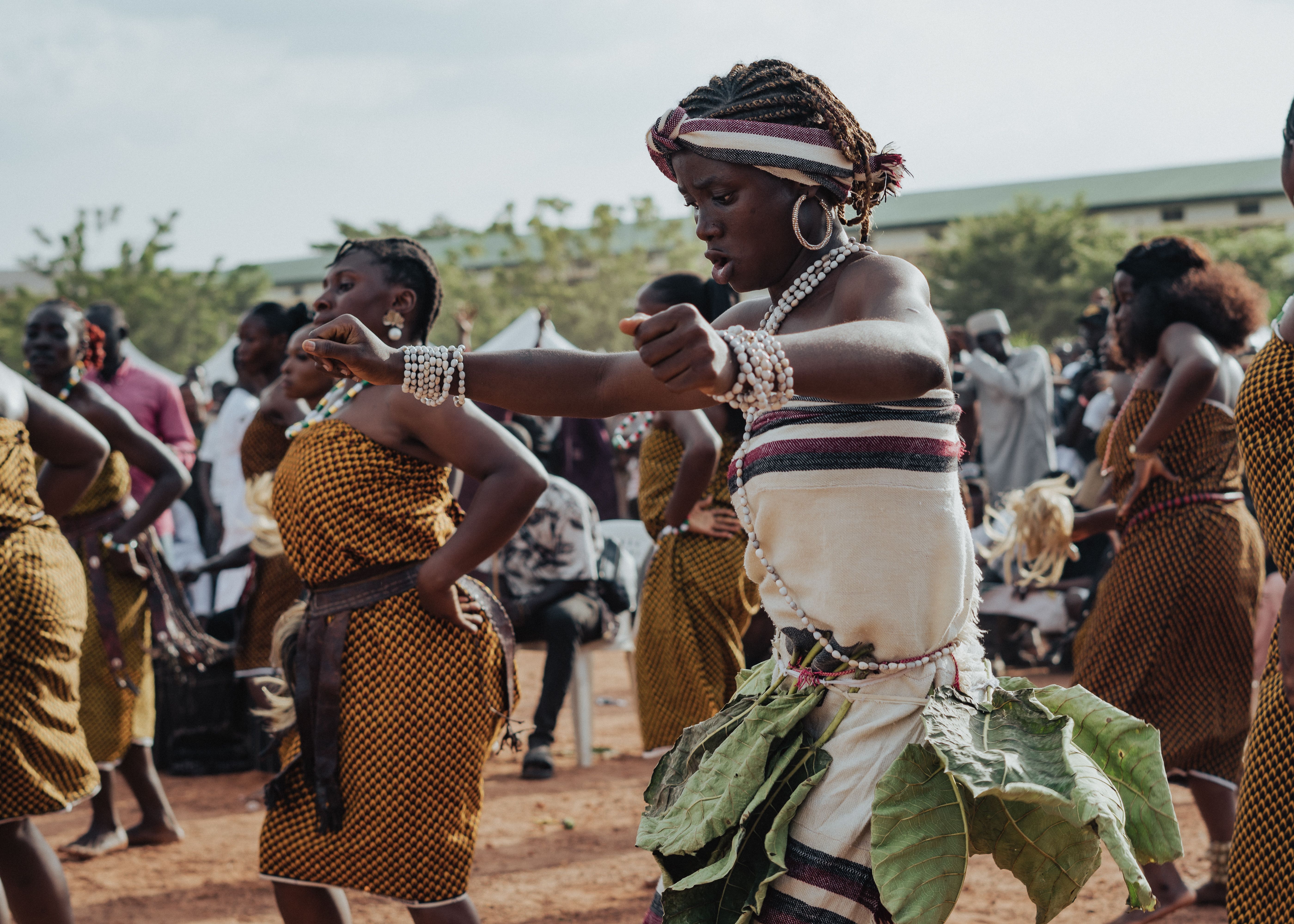
Ivanga is the Fang ceremonial dance most associated with public celebration and communal gathering, performed during initiations, festivals, and important community milestones. What makes Ivanga visually distinctive is its combination of energetic, precise footwork; costumes crafted from natural materials found in the forest environment; and a deliberate visual vocabulary of gesture that communicates meaning to those who know how to read it.
The dance is not simply movement for its own sake. Each gesture, step pattern, and costume element carries cultural weight, functioning as an embodied text that communicates values, histories, and communal bonds. Performers do not improvise freely; they work within established forms that have been transmitted through practice and observation across generations.
Natural materials — plant fibers, feathers, bark cloth, and similar elements — are central to Fang ceremonial dress in ivanga contexts. These choices connect the performer to the natural world and, by extension, to the ancestral realm the ceremony often addresses. The visual and kinetic language of ivanga is inseparable from its spiritual and social purpose.
Byeri and Bwiti Anchor Fang Ancestral Ritual
Byeri and Bwiti represent the deepest layer of Fang ceremonial performance—religious and initiation practices in which dance directly engages the ancestral world. At the same time, ivanga marks communal celebration; Byeri and Bwiti function within more restricted, sacred frameworks tied to initiation rites and spiritual communication.
Byeri (also rendered as Biere) centers on venerating ancestral relics and is performed in contexts where the community seeks connection with those who have come before. The dance movements, music, and ritual objects involved are not casual — participation requires initiation and carries serious spiritual responsibility.
Bwiti is a broader ritual and philosophical system present across several Central African peoples, but among the Fang it has developed a distinct character. Bwiti ceremonies can last extended periods and involve dance as one component of a larger spiritual process that includes music, oral recitation, and altered states of consciousness. Integrating dance into this framework shows that Fang performance is rarely a standalone act—it is part of a relational, spiritual ecology.
The Role of Fang Musical Instruments in Ceremony
Fang dance traditions are inseparable from the musical forms that animate them, and the instruments used in ceremony carry their own cultural significance. The mvet, a bridge-harp unique to Central African forest cultures, is among the most iconic instruments in Fang tradition — used not only to accompany dance but also for epic storytelling performances that can last through the night.
Alongside the mvet, Fang ceremonial music uses large drums to set the rhythmic foundation for collective movement, along with xylophones, wooden trumpets, and the sanza (a thumb piano common across Central Africa). These instruments do not merely provide a backdrop; they structure the performance, signal transitions, and communicate to dancers and audience alike.
|
Instrument |
Type |
Primary Role in Ceremony |
|
Mvet |
Bridge-harp |
Accompaniment and epic storytelling |
|
Big drums |
Percussion |
Rhythmic foundation for dance |
|
Xylophone |
Melodic percussion |
Melodic layering in ensemble |
|
Wooden trumpets |
Wind |
Signaling and ceremonial marking |
|
Sanza |
Thumb piano |
Textural and melodic support |
The ensemble nature of Fang ceremonial music reinforces the dance's communal character. No single performer dominates; the collective sound and movement express the group's unity and shared purpose.
Preservation Challenges Facing Fang Dance Traditions
Fang dance traditions face real pressure from modernization, urbanization, and the broader forces of globalization that have reshaped daily life in Equatorial Guinea over recent decades. As younger generations migrate to cities or engage primarily with global media, transmitting ceremonial knowledge—which historically required sustained community participation—becomes harder.
The challenge is not simply that ceremonies are forgotten. Ceremonies like Bwiti and Byeri require initiation, extended learning, and community infrastructure to perform authentically. When that infrastructure weakens, the traditions either go dormant or shift into more performative, tourist-facing forms that lose their original spiritual and social context. Both outcomes represent a real cultural loss, even when the visual elements survive.
Efforts to document and share these traditions—through recording, cultural education, and diaspora community engagement—offer one pathway to continuity. The small but present Equatoguinean diaspora in the United States carries fragments of this heritage, and platforms that create space for Equatoguinean cultural heritage to be recognized and shared play a meaningful role in keeping it visible.
Regional and Ethnic Variation in Equatorial Guinea's Dance Heritage
Equatorial Guinea's dance traditions are not uniform, and that diversity is itself a form of cultural richness worth understanding. The contrast between Bubi and Fang ceremonial practice illustrates this clearly.
The Abira ceremony of the Bubi people is focused on communal purification — a ritual intended to rid the community of malevolent forces and restore social and spiritual harmony. Its ceremonial logic, performers, and context differ substantially from Fang practices like ivanga or Bwiti. Both are valid, important expressions of Equatorial Guinea traditional dance, but they answer different cultural questions and belong to different peoples.
Recognizing this variation matters because it pushes back against the tendency to flatten African cultural traditions into a single, undifferentiated category. The Fang of the mainland and the Bubi of Bioko Island have developed their ceremonial lives in response to different environments, histories, and social structures. Honoring that specificity underpins genuine cultural respect.
Honoring the Depth of Fang Cultural Heritage
The Fang people of Equatorial Guinea have built a ceremonial dance tradition of genuine complexity — one that encompasses the communal energy of ivanga, the ancestral gravity of Byeri, and the spiritual depth of Bwiti, all held together by the communal space of the abaá and the layered sound of instruments like the mvet and sanza. Understanding these traditions means accepting their specificity: they are not interchangeable with the Bubi's Abira ceremony, nor with the performance cultures of neighboring countries. Each tradition belongs to a particular people, place, and history.
For the Equatoguinean diaspora in the United States, maintaining awareness of these distinctions is itself a form of cultural stewardship. When communities gather, teach, and celebrate with accuracy and depth, they pass on something more durable than a surface-level performance — they transmit a worldview. The pressures of modernization are real, but so is the resilience of communities that choose to keep their ceremonial knowledge alive.
Equatoguinean community members, cultural practitioners, and anyone who wants to support the visibility of traditions like Fang dance are welcome to connect with the broader community on United Tribes, where diverse heritage communities find space to be seen, celebrated, and heard.
Frequently Asked Questions
Is Abira a Fang dance tradition from Equatorial Guinea?
Abira is not a Fang tradition. It is a purification ceremony practiced by the Bubi people of Bioko Island, intended to cleanse the community of evil and misfortune. The Fang people of mainland Equatorial Guinea have distinct ceremonial dance traditions, including ivanga, Byeri, and Bwiti.
What is the abaá and how does it relate to Fang dance?
The abaá is a traditional communal gathering space in Fang culture, sometimes called the "house of the word." It serves as a site for community deliberation, storytelling, and ceremonial performance, making it a central institution for transmitting Fang dance and oral heritage across generations.
How is ivanga different from Bwiti in Fang culture?
Ivanga is a celebratory ceremonial dance performed at festivals, initiations, and community milestones, known for energetic footwork and natural-material costumes. Bwiti is a deeper spiritual and initiation system in which dance is one element of an extended ritual process involving music, recitation, and communion with ancestors.
Are there Equatoguinean cultural events in the United States?
Equatoguinean diaspora communities in the United States are small, and large-scale cultural festivals are not widely documented. However, diaspora members do maintain cultural connections through community gatherings, and growing digital platforms are increasingly helping Equatoguinean heritage gain visibility in multicultural spaces.
What instruments accompany Fang ceremonial dances?
Fang ceremonial performances typically feature the mvet (a bridge-harp used for dance accompaniment and epic storytelling), large drums, xylophones, wooden trumpets, and the sanza (thumb piano). Together, these instruments structure the rhythm, signal ceremonial transitions, and reinforce the communal character of the performance.
How are Fang dance traditions transmitted to younger generations?
Fang dance traditions are historically transmitted through direct community participation, observation, and initiation processes that require sustained engagement over time. Urbanization and globalization have made this transmission more difficult, and cultural documentation, diaspora community events, and digital platforms now play an increasingly important role in keeping these traditions alive.
Find your community: Equatorial Guinean businesses near you on United Tribes.
Make United Tribes Your Preferred Source
Add United Tribes on Google to get the latest stories, cultural updates, and community events directly in your Google Search and Top Stories.