

Key Takeaways
- The Garifuna people have a unique mixed heritage. Descended from Africans, Arawak, and Carib peoples, Garifuna communities first settled on Honduras's Caribbean coast in 1797 after exile from Saint Vincent.
- UNESCO recognized Garifuna culture as irreplaceable world heritage. The Garifuna language, music, and dance were proclaimed a Masterpiece of the Oral and Intangible Heritage of Humanity in 2001 and inscribed in 2008.

Welcome to United Tribes
Where Honduran Culture Comes Alive
Join Your Tribe
Connect with your people
Discover Events
Watch parties & festivals
Find Honduran Businesses
Restaurants, markets & more
Earn Crown Credits
Get rewarded for engaging
- Punta is the defining musical tradition of Garifuna identity. This energetic drum-driven genre has roots in African-indigenous traditions and has grown from ceremonial practice to international recognition since the 1970s.
- The Garifuna language belongs to the Arawakan family. It carries African, Carib, and French influences, including counting terms and vocabulary from Yoruba and Bantu.
- Honduras launched a national Garifuna preservation program in 2023. The "Ruta Garífuna" initiative created a coordinated framework to safeguard language, dance, handicrafts, and cultural exchange nationwide.
Along Honduras's Caribbean coast, a culture unlike any other in the Americas has endured for over two centuries — shaped by Africa, the indigenous Caribbean, and the sea. The Garifuna people carry a living heritage of language, music, and ceremony that has survived exile, displacement, and decades of cultural pressure. Understanding their story means understanding one of the most remarkable examples of community-led preservation in the Western Hemisphere.
Who are the Garifuna people of Honduras?
The Garifuna are a people of African, Arawak, and Carib descent who arrived on Honduras's Caribbean coast in 1797 after British colonial forces exiled them from their ancestral island of Saint Vincent, known in Garifuna as Yurumein. They first landed on the island of Roatán. They gradually spread to mainland settlements including Trujillo in the department of Colón, establishing the coastal communities that define Garifuna Honduras to this day.
Their origins are inseparable from their identity. The fusion of African resistance and Amerindian tradition produced a people who refused assimilation at every turn. This dual heritage—neither purely African nor purely indigenous—gave rise to a distinct culture that blended spiritual practice, language, agriculture, fishing, and music into a coherent, resilient way of life. Today, approximately 43,111 Garifuna people live across roughly 54 coastal settlements in six Honduran departments: Colón, Gracias a Dios, Cortés, Islas de la Bahía, Atlántida, and Francisco Morazán.
Their broader Honduran cultural heritage also extends transnationally. Garifuna communities exist in Belize, Guatemala, Nicaragua, and increasingly in U.S. cities, carrying their traditions far beyond the Central American coast and sustaining transnational ties that reinforce a shared Afro-indigenous identity.
The Garifuna Language Preserves a World Within Words
The Garifuna language is one of the most linguistically distinctive tongues in the Americas, belonging to the Arawakan language family while absorbing significant elements from African languages, Island Carib, and French. Its vocabulary includes counting terms and words traceable to Yoruba and Bantu origins — a direct linguistic fingerprint of the community's African ancestry embedded in everyday speech.
|
Language Influence |
Origin |
Example Domain |
|
Arawakan base |
Indigenous Caribbean |
Core grammar and vocabulary |
|
African elements |
Yoruba and Bantu |
Counting terms, ceremonial words |
|
Island Carib |
Caribbean indigenous |
Kinship and nature terms |
|
French borrowings |
Colonial Caribbean contact |
Daily household vocabulary |
|
Spanish influence |
Regional contact language |
Modern and administrative terms |
Efforts to document Garifuna began formally in the 1950s with the Carib Language Group's first dictionary. Later publications such as *Conversemos en Garifuna* (1991) and *The People's Garifuna Dictionary* (1993) expanded the written record. Translations including portions of the New Testament brought the language into new textual domains, signaling both its vitality and the community's investment in its continuation.
In communities like Sangrelaya on the Honduran coast, bilingualism in Garifuna and Spanish persists with notably positive attitudes toward the language across multiple social domains. Yet threats remain real. Economic migration pulls younger generations toward Spanish-dominant cities, and Garifuna culture has received minimal formal support within national education systems until recently. Honduras's Secretaría de Educación launched bilingual intercultural education programs as far back as 1993 through the PRONEEAAH initiative and has since produced educational materials and literary collections in Garifuna to reinforce cultural identity through formal schooling.
Punta and the Power of Garifuna Music
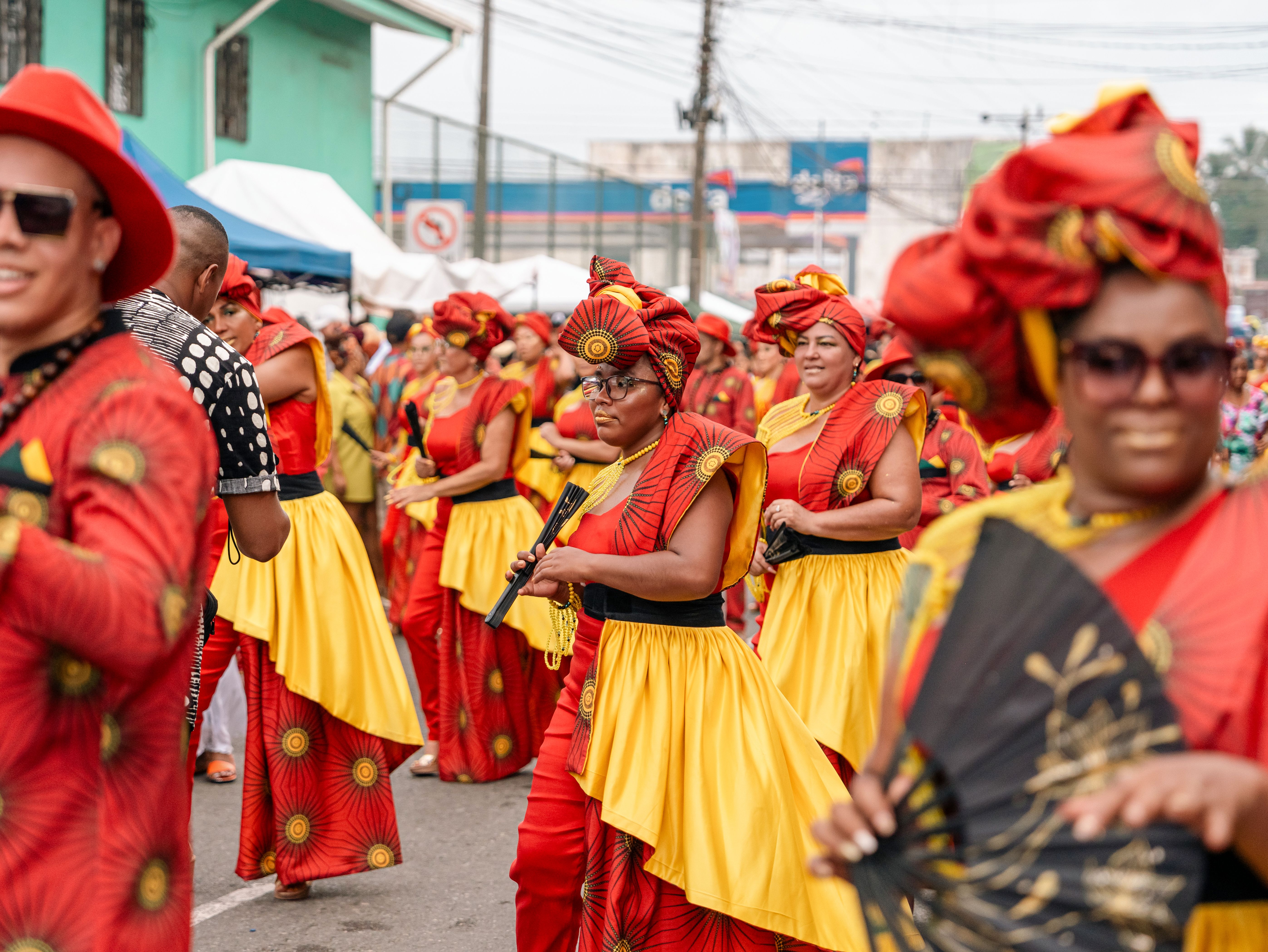
Punta is the heartbeat of Garifuna culture — an energetic, participatory musical and dance tradition rooted in the community's African-indigenous heritage and performed at social gatherings, ceremonies, and celebrations along the Honduras Caribbean coast.
At its core, punta is driven by two drums: the primero and the segunda. These are joined by the conch shell, maracas, turtle shell, donkey jaw used as a güiro, comb, and claves — an ensemble that reflects both African percussion traditions and the natural materials of coastal Caribbean life. The dance itself is equally expressive, with performers using rapid hip movements and footwork that carry deep cultural meaning. Punta is not simply entertainment; it is a vehicle for storytelling, courtship, mourning, and communal joy.
Since the 1970s, punta has traveled well beyond its ceremonial origins. Artists from Garifuna communities began adapting the rhythm for wider audiences, and the genre gained recognition across Honduras and internationally. Songs like "Sopa de Caracol" helped introduce punta rhythms to mainstream Caribbean music audiences and brought global attention to the Garifuna community in Honduras. For the diaspora in the United States, punta performances have become anchors of cultural identity at community events, festivals, and cultural gatherings — a reminder of coastal roots that no amount of distance can erase.
UNESCO Recognition and the Weight of World Heritage
In 2001, UNESCO proclaimed the Garifuna language, music, and dance a Masterpiece of the Oral and Intangible Heritage of Humanity — one of the earliest and most significant recognitions of an Afro-indigenous living culture. The inscription was formalized in 2008, cementing an international acknowledgment that the Garifuna language, the rich oral tradition known as úraga, and the community's ceremonial and musical knowledge constitute irreplaceable world heritage.
The UNESCO designation recognized not only individual practices but the entire system of cultural knowledge transmission — the way songs carry history, ceremonies carry ethics, and storytelling carries identity from one generation to the next. Oral traditions among the Garifuna are not nostalgic relics; they are living repositories of knowledge about medicine, navigation, agriculture, and community governance.
This recognition has strengthened advocacy efforts and helped Garifuna communities argue for greater inclusion in national cultural policy. However, the practical challenges of sustaining a culture without strong institutional support remain pressing, and the community's resilience still depends far more on its internal systems than on external validation.
Community Transmission and the Role of Elders
Cultural survival among the Garifuna has always been a community-led project, with elders at its center. Elders lead ceremonies, pass down oral histories, teach the rhythms of the primero and segunda, and maintain the spiritual practices that connect the living to ancestral knowledge. This transmission happens not in classrooms but in kitchens, on porches, at wakes, and in the rhythms of daily coastal life.
The pressures on this system are significant. Economic migration draws working-age Garifuna to Honduran cities or to the United States, creating gaps in intergenerational contact. Discrimination against Garifuna communities within broader Honduran society has historically limited their access to education and political representation. And the near-absence of Garifuna language instruction in most schools until recent decades has left many young community members with only partial fluency.
Community organizations have responded with cultural festivals, language camps, music workshops, and documentation projects that work alongside elder knowledge-keepers. The Honduran cultural heritage of the Garifuna cannot be reduced to an artifact — it must be lived, performed, and transmitted to survive.
Honduras's Ruta Garífuna Program
Honduras formalized a new national commitment to Garifuna preservation in November 2023 by launching the "Ruta Garífuna" program. This initiative created a coordinated national framework to safeguard and promote the Garifuna language, dance, handicrafts, and cultural exchanges, drawing on interinstitutional cooperation without requiring new public funding.
The Ruta Garífuna represents a meaningful policy shift—from treating Garifuna culture as a regional curiosity to recognizing it as a pillar of national identity and a potential driver of cultural tourism along Honduras' Caribbean coast. By creating structured pathways for cultural promotion, the program aims to support community practitioners, expand visibility for Garifuna traditions, and attract visitors to the coastal settlements where this heritage remains most alive.
Paired with the bilingual education materials developed through earlier PRONEEAAH programs, these efforts mark a gradual but significant broadening of institutional support for a community that has historically relied on its own determination to survive.
A Living Heritage Rooted in the Caribbean Shore
The Garifuna people of Honduras represent one of the most extraordinary examples of cultural continuity in the Americas. From their origins in exile on Saint Vincent to their roots along the Caribbean coast, they have built a civilization of language, music, and oral tradition that UNESCO has recognized as a gift to all of humanity. Their language carries the fingerprints of Africa and the indigenous Caribbean. Their drums speak across centuries. Their elders hold knowledge that no digital archive can fully replicate.
What makes the Garifuna story so resonant is that preservation has never been passive. It has required active choice — to speak the language at home, to teach the punta rhythm to a child, to keep the ceremonial fires burning even when economic pressures and institutional neglect made it harder each generation. The Ruta Garífuna program and bilingual education initiatives offer new institutional scaffolding. However, the real continuity lives in the communities themselves, in the coastal settlements where the primero drum still sounds at dusk.
Are you looking to connect with communities whose heritage runs just as deep and whose stories deserve just as much visibility? Explore Honduran and other cultural communities on United Tribes and discover the traditions, businesses, and voices that make every tribe worth knowing.
Frequently Asked Questions
When did the Garifuna first arrive on Honduras's Caribbean coast?
The Garifuna arrived on Honduras's Caribbean coast in 1797, landing first on the island of Roatán after British colonial forces exiled them from Saint Vincent. They later moved to mainland settlements such as Trujillo in the department of Colón, establishing communities that persist today.
What makes the Garifuna language different from Spanish or other regional languages?
Garifuna belongs to the Arawakan family and is distinct from Spanish, the dominant language of Honduras. Its vocabulary includes African-origin words traceable to Yoruba and Bantu languages, alongside Island Carib and French borrowings, making it linguistically unique in Central America.
How many Garifuna people live in Honduras today?
According to the 2013 Honduran census, approximately 43,111 Garifuna people live in Honduras, spread across roughly 54 coastal settlements in six departments including Colón, Atlántida, Cortés, Gracias a Dios, Islas de la Bahía, and Francisco Morazán.
What instruments are traditionally used in Garifuna punta music?
Garifuna punta music features the primero and segunda drums as its core instruments, accompanied by the conch shell, maracas, turtle shell, donkey jaw used as a güiro, comb, and claves. This ensemble reflects both African percussion traditions and the natural materials available in the Caribbean coastal environment.
Does a Garifuna diaspora community exist in the United States?
Yes, Garifuna communities from Honduras and other Central American countries have established a notable diaspora presence in U.S. cities. Diaspora members maintain cultural ties through punta performances, community festivals, and language efforts, using music and ceremony as anchors of identity far from the Caribbean coast.
What is the úraga tradition in Garifuna culture?
Úraga refers to the rich oral tradition at the heart of Garifuna cultural knowledge, encompassing songs, narratives, and ceremonial speech that transmit history, ethics, and community identity across generations. UNESCO specifically recognized the úraga tradition as part of its 2001 proclamation of Garifuna language, music, and dance as Intangible Heritage of Humanity.
Find your community: Honduran businesses near you on United Tribes.
Make United Tribes Your Preferred Source
Add United Tribes on Google to get the latest stories, cultural updates, and community events directly in your Google Search and Top Stories.