
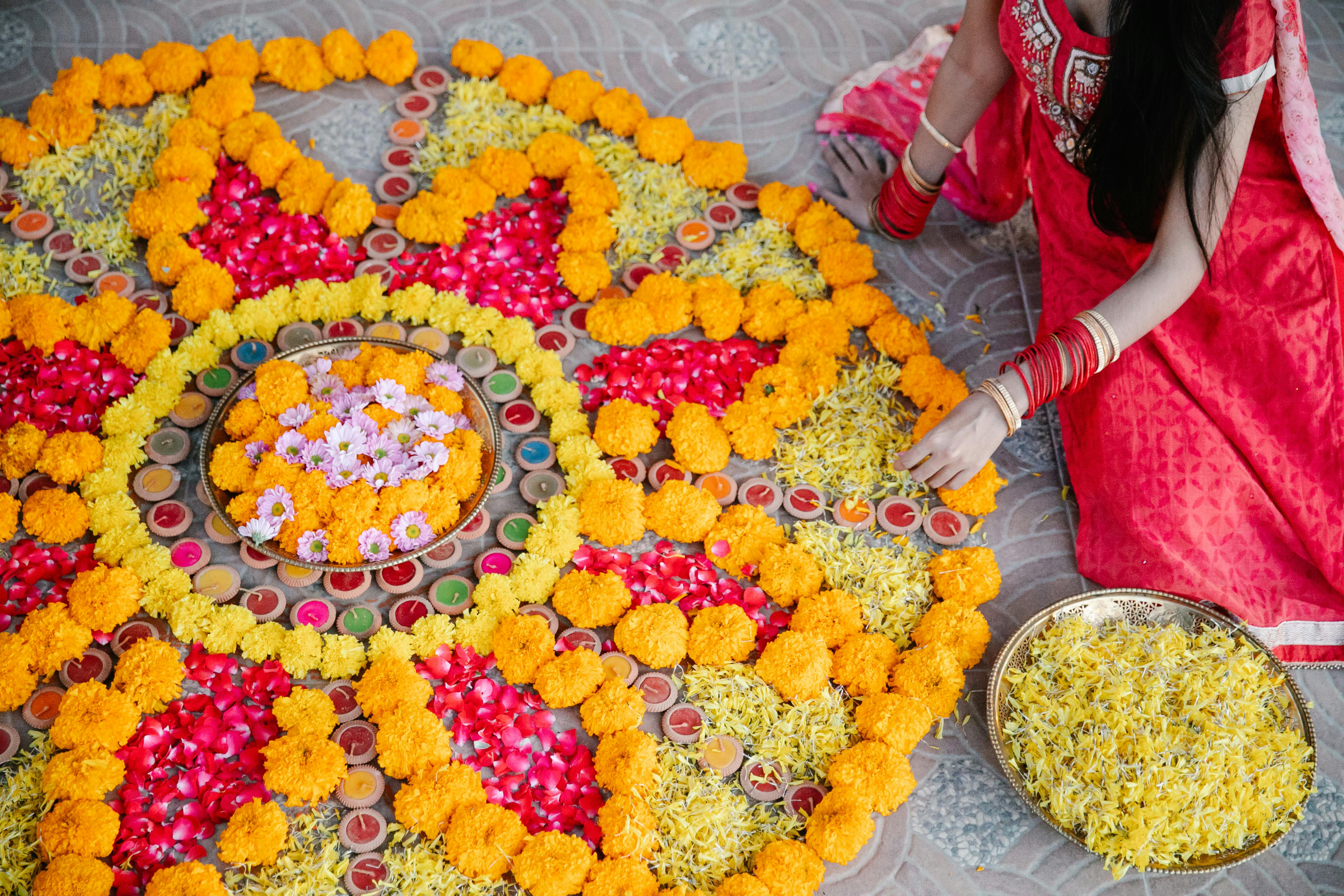

At the threshold of countless Indian-American homes across the United States, intricate patterns of colored powder, rice, and flower petals create stunning geometric designs that serve as far more than decorative art. These are Rangoli patterns, sacred expressions of welcome, protection, and blessing that have been passed down through generations. During Diwali and other significant festivals, this ancient practice transforms entryways into spiritual canvases that honor tradition while adapting to modern American life.
The Rangoli art meaning extends deep into Hindu philosophy and Indian cultural heritage, representing the cyclical nature of life, the invitation of prosperity, and the creation of sacred space. For Indian-Americans maintaining their cultural roots while building new lives in the United States, Rangoli serves as a powerful bridge between ancestral wisdom and contemporary expression.

Welcome to United Tribes
Where Indian Culture Comes Alive
Join Your Tribe
Connect with your people
Discover Events
Watch parties & festivals
Find Indian Businesses
Restaurants, markets & more
Earn Crown Credits
Get rewarded for engaging
The Sacred Origins and Spiritual Foundation
Rangoli, known by various names across different regions of India, such as Kolam in Tamil Nadu, Alpona in Bengal, and Mandana in Rajasthan, carries profound spiritual significance rooted in ancient Vedic traditions. The practice is believed to invite Lakshmi, the goddess of wealth and prosperity, into homes while simultaneously creating a protective barrier against negative energies.
The geometric patterns traditionally begin at sunrise, when the cosmic energy is considered most pure and receptive. Indian-American families often adapt this timing to fit their work schedules, creating their designs during evening hours or weekend mornings, maintaining the spiritual intention even as they adjust to American rhythms of life.
The Philosophy of Impermanence
Central to the meaning of Rangoli art is the concept of impermanence. These beautiful creations are designed to be walked on, weathered by rain, and eventually fade away. This temporary nature reflects Buddhist and Hindu teachings about the transient nature of material beauty and the importance of creating without attachment to permanent outcomes.
Indian-American communities have found this philosophical aspect particularly resonant during challenging times, using Rangoli creation as a meditative practice that emphasizes process over permanence. The act of creating something beautiful that will naturally fade becomes a form of spiritual practice, teaching acceptance and mindfulness.
Traditional Patterns and Their Symbolic Meanings
Rangoli patterns carry specific meanings encoded in their geometric forms, with each design element serving as a visual prayer or intention. Traditional motifs include lotus flowers representing purity and spiritual awakening, peacocks symbolizing grace and beauty, and geometric mandalas that represent the cosmos and divine order.
The diya or oil lamp pattern remains one of the most popular designs during Indian Diwali traditions in the USA celebrations, with concentric circles radiating outward to symbolize the spreading of light over darkness. Paisley motifs, known as mango designs, represent fertility and abundance, making them particularly favored during wedding celebrations and harvest festivals.
Sacred Geometry in Practice
The mathematical precision required for traditional Rangoli patterns reflects ancient Indian understanding of sacred geometry. Designs typically begin with a central point, expanding outward in symmetrical formations that mirror the structure of mandalas used in meditation practices. Indian-American families often use these geometric principles to teach children about both cultural heritage and mathematical concepts.
Modern practitioners have discovered that creating these intricate patterns requires a meditative focus that naturally calms the mind and reduces stress, benefits that prove especially valuable in fast-paced American lifestyles. The counting of dots, measurement of angles, and repetitive motions create a rhythm that many describe as deeply therapeutic.
The Language of Colors in Rangoli
Color selection in Rangoli art carries deep symbolic meaning, with each hue representing specific spiritual qualities and intentions. Red powder, made from turmeric and lime, symbolizes strength and fertility, while yellow represents knowledge and learning, colors particularly significant during Saraswati Puja celebrations among Indian-American students and educators.
White rice powder or chalk represents purity and peace, often used as the foundation color for more complex designs. Green symbolizes new beginnings and nature's harmony, making it popular during spring festivals like Holi. Blue, representing the infinite sky and divine consciousness, often appears in designs honoring Krishna during Janmashtami celebrations.
During Diwali celebrations, Indian-Americans traditionally emphasize warm colors, such as oranges, reds, and golds, that represent the festival's central theme of light triumphing over darkness. Many families combine traditional colored powders with modern materials like colored sand and even LED lights to create designs that honor tradition while embracing innovation.
Diwali Traditions and Rangoli in American Communities
Indian Diwali traditions in the USA have evolved to accommodate apartment living, community celebrations, and climate differences while maintaining the essential spiritual elements of Rangoli practice. Indian-American families living in apartments often create smaller designs using removable materials or participate in community center celebrations where large collaborative Rangoli designs become focal points for festival gatherings.
Community associations across cities like New York, Los Angeles, and Houston organize Rangoli competitions during Diwali season, bringing together multiple generations to share techniques and stories. These events serve dual purposes: maintaining cultural traditions and educating broader American communities about Indian heritage through visual art demonstrations.
Adapting Traditions for American Settings
Weather considerations have led to creative adaptations of traditional outdoor Rangoli practices. Many Indian-American families create indoor designs using washable materials or develop covered outdoor spaces where their threshold art can be protected from rain and snow. Some communities have pioneered the use of stencils and templates that allow for quicker creation while maintaining traditional pattern integrity.
Modern materials like colored salt, sand, and synthetic powders have replaced some traditional ingredients, offering longer-lasting designs that can withstand American weather patterns. However, many families maintain the use of traditional materials like rice flour and flower petals for their spiritual significance, despite the practical challenges.
Evolution with Modern Materials and Techniques
Contemporary Rangoli patterns in American settings often incorporate readily available materials like colored chalk, sand art supplies, and even digital projections for large-scale community displays. Art supply stores in areas with significant Indian populations now stock specialized Rangoli materials, making the practice more accessible to families maintaining their traditions in diaspora communities.
Flower petal Rangoli designs have gained popularity for their natural beauty and easier cleanup, with Indian-American families utilizing flowers available in American markets, like roses, marigolds, and chrysanthemums, to create designs that honor traditional aesthetics while using locally sourced materials.
Some practitioners have embraced technology, using design software to plan complex patterns or sharing their creations through social media platforms that connect Indian-American communities across vast geographic distances. Online tutorials and virtual workshops have become particularly valuable for preserving knowledge and teaching younger generations who may have limited access to traditional teachers.
Teaching Heritage Through Art
For Indian-American families, Rangoli creation serves as an informal educational tool that transmits cultural values, mathematical concepts, and artistic skills to children born and raised in the United States. Parents report that the collaborative nature of creating family Rangoli designs provides natural opportunities to share stories about grandparents, homeland traditions, and cultural identity.
Many Indian-American children participate in school cultural fairs and diversity celebrations by demonstrating Rangoli techniques, becoming cultural ambassadors who educate their classmates about Indian traditions. These experiences help maintain cultural pride while building bridges between communities through shared appreciation for artistic beauty and spiritual meaning.
Preserving Sacred Traditions Through Artistic Expression
The practice of creating Rangoli patterns continues to serve as a vital bridge between ancestral wisdom and contemporary American life for Indian communities across the United States. Through the simple yet profound act of arranging colored powders into sacred geometric forms, families maintain spiritual connections that transcend geographic distance and cultural adaptation. Whether created for Diwali celebrations, community festivals, or personal meditation, Rangoli art carries forward the essential Indian traditions that ground identity and invite blessings into daily life.
As Indian-American communities continue to grow and evolve, the adaptability of Rangoli practice demonstrates the resilience of cultural traditions that can flourish in new environments while maintaining their spiritual essence. The temporary nature of these beautiful designs teaches valuable lessons about creating beauty for its own sake. At the same time, their geometric precision connects practitioners to ancient mathematical and spiritual wisdom that remains relevant in modern contexts.
Visit United Tribes today and discover more about Indian culture, community celebrations, events, and traditions that keep heritage alive in American settings.


