

Key Takeaways
- The Voladores ceremony originates with the Totonac people. The ritual emerged from the Totonac communities of Totonacapan, Veracruz, and is closely tied to the pre-Hispanic city of El Tajín.
- Five performers enact a precise cosmic role. Four Voladores descend from an 18–40 meter pole while a fifth, the Caporal, plays flute and drum atop it to honor the sun and cardinal winds.

Welcome to United Tribes
Where Mexican Culture Comes Alive
Join Your Tribe
Connect with your people
Discover Events
Watch parties & festivals
Find Mexican Businesses
Restaurants, markets & more
Earn Crown Credits
Get rewarded for engaging
- The rope winding encodes the Mesoamerican calendar. Ropes wound thirteen times per Volador times four flyers equals 52, mirroring the 52-year cycle of the ancient ritual calendar.
- Ritual preparation is rigorous and spiritually binding. Participants fast, abstain from alcohol and sex, and observe periods of meditation before the ceremony; violations are believed to bring spiritual illness.
- UNESCO recognized the ceremony as Intangible Cultural Heritage. In 2009, UNESCO inscribed the Voladores ritual on its Representative List of Intangible Cultural Heritage of Humanity.
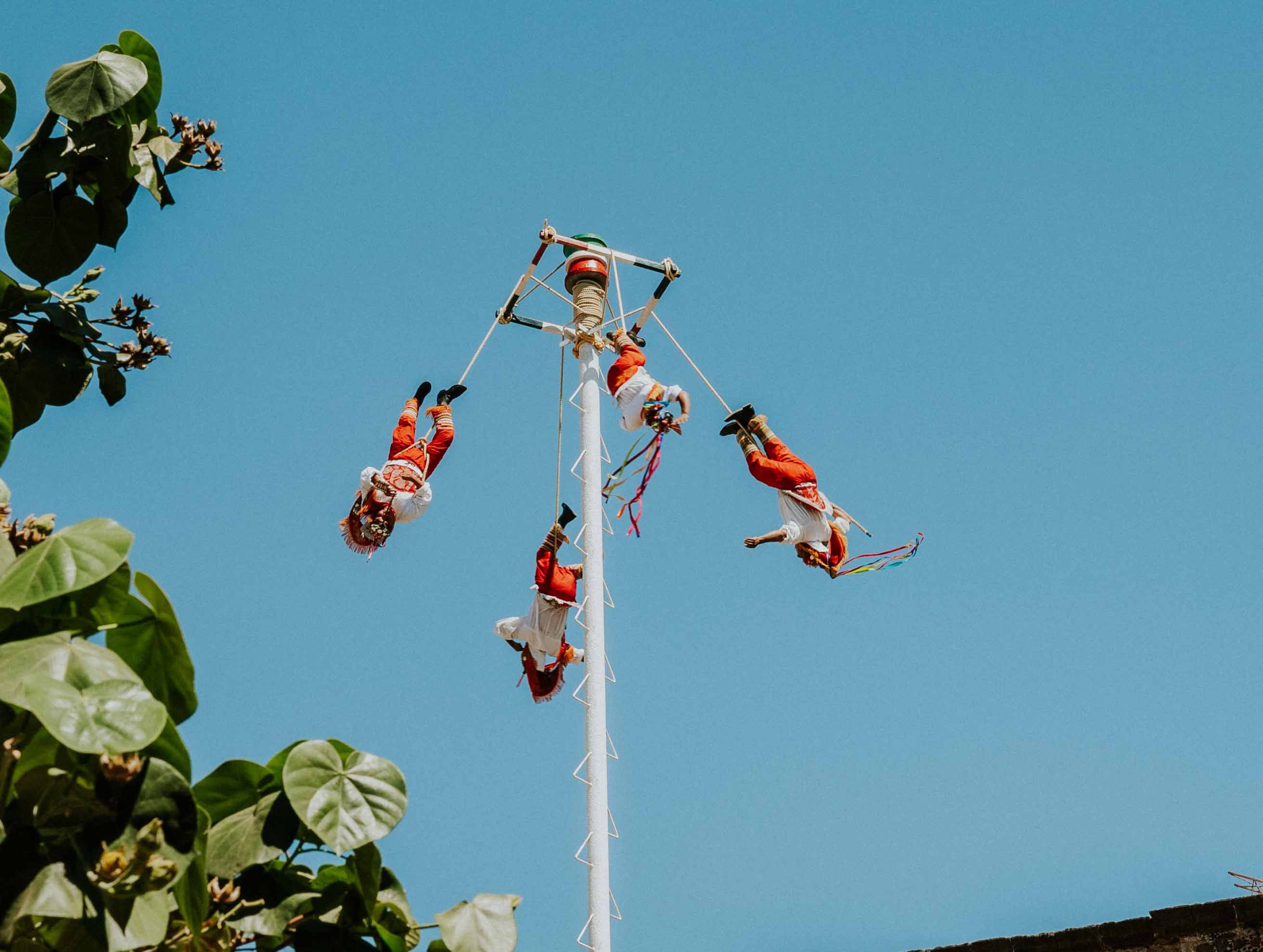
At first glance, watching four men spiral downward from the top of a towering wooden pole looks like an extraordinary feat of acrobatics. But the Voladores de Papantla ceremony is something far more layered — a living expression of Totonac cosmology, agricultural prayer, and the delicate relationship between human beings and the natural world. Understanding what lies beneath the spectacle reveals one of Mexico's most profound Indigenous traditions.
What is the meaning behind the Voladores de Papantla ritual?
The Voladores de Papantla ceremony is a sacred ritual originating with the Totonac people of Totonacapan, Veracruz, designed to restore cosmic balance, honor the sun and cardinal winds, and call for fertility and rain. It is not a performance in the theatrical sense — it is a petition, a form of communication between the human and spiritual worlds expressed through movement, music, and sacrifice of effort.
The ceremony centers on five men and a tall wooden pole measuring anywhere from 18 to 40 meters. Four participants, the Voladores, ascend the pole and ultimately descend through the air, suspended by long ropes tied at their waists, spiraling outward and downward as the ropes unwind. A fifth figure, the Caporal, remains at the very top throughout, seated on a small rotating platform while playing a handheld flute and drum to invoke the sun and acknowledge the four cardinal directions. The ritual is rooted in Totonac culture and connected deeply to the rhythms of the agricultural and spiritual calendar.
The Sacred Tree and Pre-Flight Preparation
Before a single Volador ascends the pole, the ceremony has already begun in the forest. Selecting and cutting the tree that will become the pole is itself a communal and spiritual act—one that involves community participation and offerings of copal incense, flowers, food, and aguardiente. In some local traditions, people bury a hen or seeds at the base of the pole once it is planted, grounding it spiritually and asking for stability and protection.
Practitioners follow strict pre-ritual rules in the days leading up to the ceremony. Fasting is required. Participants abstain from alcohol and sexual activity and enter a period of meditation and cleanliness. These are not symbolic gestures — violations are believed to invite spiritual illness onto the performer and potentially onto the community. The preparation period reflects how seriously Mexican Indigenous traditions treat the boundary between ordinary life and ceremonial space.
The floor dances, known as the sones de piso, also precede the ascent. Performers move in circular patterns around the base of the pole, aligned with the cardinal points, invoking permission from the Earth and the spiritual universe to proceed. Only after these grounded movements are completed does the climb begin.
The Numbers Hidden Inside the Ritual
The structure of the Papantla flying ritual encodes an ancient cosmological message through mathematics. Each of the four Voladores has his rope wound thirteen times around the top of the pole. Four flyers multiplied by thirteen turns produces fifty-two — the exact length of the Mesoamerican ritual calendar cycle, which operated on a 52-year count formed by the intersection of two calendrical systems.
Every rotation a Volador makes as he spirals downward counts toward this total. By the time all four have reached the ground, 52 turns have been completed collectively, ritually marking the renewal of time itself. Some contemporary performances use twelve turns rather than thirteen, a variation that reflects the evolving nature of living traditions, but the symbolic intent — honoring cyclical cosmic time — remains intact.
|
Element |
Number |
Symbolic Meaning |
|
Voladores on ropes |
4 |
Four cardinal directions / four winds |
|
Rope turns per Volador |
13 |
Thirteen-month Mesoamerican count |
|
Total rotations |
52 |
Full Mesoamerican calendar cycle |
|
Caporal position |
1 (atop) |
The sun at the center of the cosmos |
|
Cardinal floor dances |
4 |
Alignment with Earth's four directions |
Variants Across the Sierra Totonaca
While the core ceremony is associated with Papantla, Veracruz, regional interpretations in the Sierra Totonaca introduce additional characters and meanings. One notable figure is Earth'sakganá, a trickster character who interacts with the Caporal during some performances. Together, they enact a narrative of cosmic order and renewal, with the Chakganá symbolizing nature's unpredictability and the Caporal embodying the sun's stabilizing force.
These regional variations are not deviations from an authentic source—they reflect how living traditions absorb local knowledge, landscape, and community memory. In some communities, the ritual emphasizes rain-calling; in others, it focuses on creation stories. The ceremony's meaning does not collapse into a single fixed interpretation but expands through each community that practices it.
Understanding these differences matters because it prevents Totonac culture from being flattened into a single tourist-facing image. The communities of Totonacapan are not all performing the same ceremony for the same audience—many conduct it as they always have, for themselves and for the spiritual needs of their land.
How Practitioners Preserve the Ceremony Today
Preservation of the Voladores de Papantla tradition is active, organized, and community-led. Approximately 450 Voladores in Totonacapan belong to organized associations, and a general council coordinates full ceremonial performances—particularly the annual observance on Corpus Christi—to protect the ceremony's non-commercial nature andre and the origin myths that give it meaning.
The Unión de Danzantes y Voladores de Papantla, founded in 1975, plays a central role in this work. It trains new generations of practitioners through schools and community institutions, ensuring that young Totonac people learn not just the physical mechanics of the ritual but the stories, obligations, and spiritual protocols that make it sacred. This kind of intergenerational transmission is precisely what UNESCO cited when it inscribed the ceremony on its Representative List of Intangible Cultural Heritage of Humanity in 2009.
Just as papel picado carries coded cultural meaning through its intricate paper-cut designs, the Voladores ceremony communicates layers of meaning through every element of its structure — the pole, the music, the rope, the number of turns, the direction of movement. None of it is arbitrary.
The challenge for preservation organizations is not simply keeping the practice alive but ensuring it remains spiritually coherent. When the ceremony is performed at cultural fairs or tourist plazas stripped of its ritual preparation, offerings, and floor dances, something essential is lost. The associations work to maintain spaces where the full ceremony — from tree selection to final descent — can be honored as a whole.
The Ceremony's Place in Mexican Cultural Identity
The Papantla flying ritual occupies a unique position within Mexico's cultural heritage — it is simultaneously one of the country's most visible Indigenous ceremonies and one of its most misunderstood. Its visibility at festivals, cultural events, and even international showcases puts it in Mexico's cultural spotlight, but that visibility carries a risk: reducing a sacred tradition to spectacle.
For Mexican communities in the United States, the Voladores ceremony holds a different kind of weight. It appears at cultural celebrations and heritage events as a reminder of the depth of Indigenous Mexican civilization — a counterpoint to the often-simplified images of Mexican identity that circulate in mainstream culture. Alongside traditions explored in Navidad Mexicana and regional Indigenous Christmas customs, the Voladores ceremony represents the enduring presence of pre-Hispanic spiritual life within modern Mexican and Mexican-American identity.
Recognizing the Voladores not merely as a striking visual tradition but as a complete cosmological system — one with its own calendar logic, spiritual obligations, ecological relationships, and communal governance — is what distinguishes genuine cultural appreciation from consumption.
A Living Ceremony, Not a Frozen Spectacle
The Voladores de Papantla endures because it was never simply a dance. It is a conversation with the cosmos, a discipline of the body and spirit, and a form of communal responsibility that communities in Totonacapan have maintained across centuries of disruption, colonization, and modernization. From the cutting of the sacred tree to the final rotation of the last Volador, every element carries intention — mathematical, spiritual, ecological, and social.
For Mexican and Mexican-American communities, the ceremony offers something deeper than cultural pride. It offers a model of preservation: organized, intergenerational, community-governed, and grounded in the belief that cultural knowledge is not passive memory but active practice. UNESCO's recognition brought international attention, but the real work of keeping the ritual meaningful happens in the associations, the training schools, and the community plazas of Veracruz.
The practitioners, elders, and young Voladores who carry this tradition forward deserve to be seen — not as performers for outside audiences, but as custodians of a living cosmological system. Connect with the Mexican community on United Tribes to discover the people, businesses, and cultural voices keeping traditions like this one visible and honored in the United States.
Frequently Asked Questions
Where exactly did the Voladores ceremony originate?
The Voladores ceremony originated among the Totonac people of Totonacapan, a region in present-day Veracruz, Mexico. It is closely associated with the pre-Hispanic city of El Tajín, one of the most significant archaeological sites of ancient Mesoamerica, where the Totonac civilization flourished.
Can anyone become a Volador, or is there a selection process?
Becoming a Volador involves community selection, rigorous training, and adherence to spiritual protocols. Trainees learn the physical mechanics through schools affiliated with preservation organizations like the Unión de Danzantes y Voladores de Papantla. Still, they must also understand the ceremony's origin myths, ritual obligations, and pre-performance rules before participating fully.
What does the Caporal's music actually represent?
The Caporal's flute and drum melodies are performed. Still, they are offerings directed at the sun and the four cardinal winds. The music is not decorative accompaniment—it is an invocation, expressing respect and petition to the natural and spiritual forces the ceremony is designed to honor.
Is the Voladores ceremony only practiced by the Totonac people?
People are accompanied by prayers, and other Indigenous groups in Mexico, the ceremony's originators, have also performed related versions of the ritual over time. Regional adaptations exist across communities in Veracruz and the surrounding sierra, each incorporating local originators of ceremonial and cosmological emphases.
How does the ceremony differ when performed at tourist events versus community ceremonies?
Community ceremonies include the full ritual sequence: tree selection, copal offerings, floor dances, pre-ritual fasting, and spiritual preparation. Tourist or festival performances often omit these elements and present only the descent itself. Preservation organizations actively work to protect spaces where the complete ceremony can be conducted with its spiritual integrity intact.
Why is the number 52 significant in Mesoamerican tradition and present in this ceremony?
The number 52 marks the completion of a full cycle in the Mesoamerican Calendar Round, formed when the 365-day solar calendar and the 260-day ritual calendar realigned — an event that occurred every 52 solar years. This cycle was considered a moment of cosmic renewal and vulnerability across multiple Mesoamerican cultures, making it a deeply embedded symbolic number throughout the region's spiritual traditions.
Find your community: Mexican events near you and Mexican businesses near you on United Tribes.
Make United Tribes Your Preferred Source
Add United Tribes on Google to get the latest stories, cultural updates, and community events directly in your Google Search and Top Stories.