
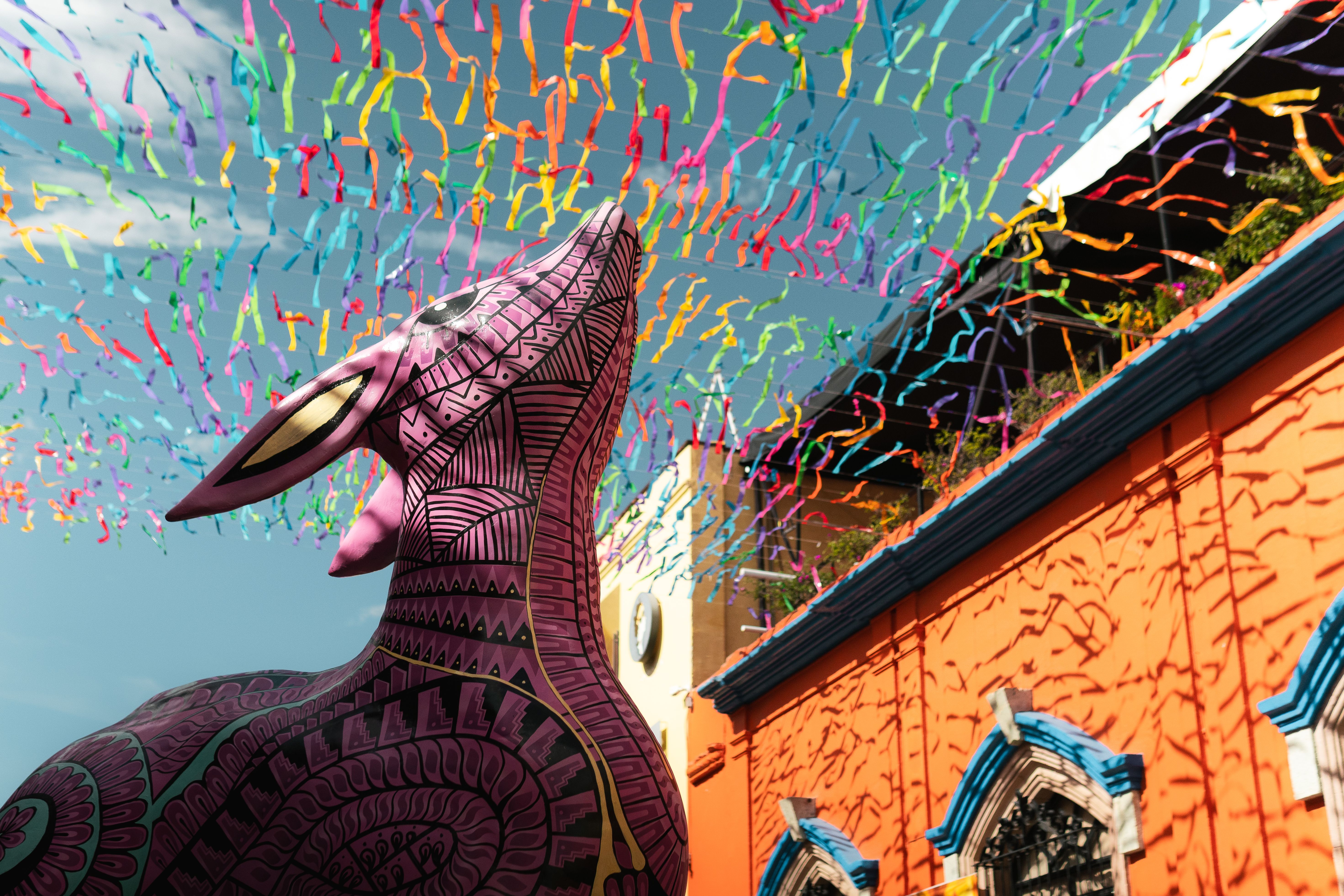

Few objects in Mexican folk art stop people in their tracks quite like an alebrije. Part dragon, part insect, part jaguar — painted in colors that have no business existing together yet somehow work perfectly — these fantastical creatures carry an artistic imagination that feels both ancient and entirely modern. As Hispanic Heritage Month continues through October 15, there's no better moment to look closely at one of Mexico's most beloved and distinctly original art forms.
A Fever Dream That Changed Mexican Art
The alebrije was born from illness. In the 1930s, a Mexico City craftsman named Pedro Linares López fell severely ill and slipped into a delirious fever dream. In that altered state, he later recounted, he found himself in a strange forest populated by impossible creatures — a donkey with butterfly wings, a rooster with bull horns, hybrid animals calling out a single nonsense word: *alebrije*. When he recovered, Linares began recreating those visions in papier-mâché, and the word became the name for them.

Welcome to United Tribes
Where Mexican Culture Comes Alive
Join Your Tribe
Connect with your people
Discover Events
Watch parties & festivals
Find Mexican Businesses
Restaurants, markets & more
Earn Crown Credits
Get rewarded for engaging
His work eventually caught the attention of Mexican artists Diego Rivera and Frida Kahlo, who became collectors. From there, alebrijes entered the cultural conversation as something genuinely new, not a reproduction of pre-Columbian imagery or a colonial craft tradition, but an original invented form rooted in one man's interior world.
The Papier-Mâché Tradition of Mexico City
Linares and his family continued refining the papier-mâché technique in Mexico City's Merced neighborhood, and his descendants carry on the practice today. The process is labor-intensive and requires great skill. Artists soak strips of newspaper or tissue paper in a paste, then layer them over wire armatures shaped into animal forms. After drying, the surface is sanded smooth, sealed, and prepared for painting.
The painting stage is where the alebrije truly comes alive. Artists use fine brushes to apply intricate geometric patterns — dots, zigzags, flowers, scales — in colors that vibrate against each other: electric yellow against cobalt blue, hot pink against forest green. No two are identical. The visual density of the surface design matters as much as the sculptural form beneath it.
Oaxacan Alebrijes and the Wood-Carving Tradition
A parallel tradition developed independently in the villages surrounding Oaxaca City, particularly in San Martín Tilcajete and Arrazola. Oaxacan wood carvers, working primarily in copal wood — a soft, light material that carves easily and dries quickly — began producing their own fantastical animal sculptures in the 1980s, partly inspired by the Mexico City tradition and partly drawing on their own regional carving heritage.
The Oaxacan style has its own character. The forms tend to be smoother and more stylized, often depicting creatures with elongated limbs, curling tails, and open mouths showing detailed teeth. Families like the Jiménez and Fuentes dynasties in San Martín Tilcajete have developed recognizable signatures that collectors specifically seek out. Entire family workshops—grandparents, parents, children—participate at different stages: one person carves, another sands, another applies the base coat, and another paints the final detail work.
The patterns Oaxacan artists use sometimes carry regional meaning. Certain symbols connect to the region's Zapotec visual heritage, while others are purely aesthetic innovations developed by individual artists over decades of practice.
What Makes an Alebrije
The defining characteristics of an alebrije are its hybrid animal form and its explosion of decorative surface patterning. There are no rules about which animals can be combined — a coyote might have eagle wings, butterfly antennae, and fish scales. A serpent might carry a rooster's comb and a deer's hooves. The combinations are left entirely to the artist's imagination, which is precisely the point.
Color saturation is non-negotiable. Alebrijes are never subtle. The palette is deliberately overwhelming, designed to make the creature feel as though it could not possibly belong to the ordinary world. This visual intensity is part of what has made alebrijes so recognizable internationally.
Cultural Popularity and Global Reach
Alebrijes gained massive visibility through Pixar's 2017 film *Coco*, which featured spirit guide animals in the unmistakable alebrije style. While the film introduced the form to audiences who had never encountered Mexican folk art before, the tradition had already been growing in visibility through international craft markets, museum collections, and cultural export programs.
The symbolism woven into Mexican celebration arts—from papel picado to alebrijes—reflects a broader cultural truth: Mexican artistic traditions use color, pattern, and form to carry meaning far beyond decoration. Alebrijes fit naturally into this lineage.
Today, alebrije artists exhibit internationally, and high-end galleries treat their work as fine art alongside contemporary painting and sculpture. At the same time, the craft remains rooted in family workshops and community practice in Oaxaca and Mexico City.
Recognizing Authentic Work
If you're interested in collecting or buying alebrijes, here are a few things to know. Authentic hand-carved Oaxacan alebrijes will show tool marks, slight asymmetries, and the texture of real wood underneath the paint. Mass-produced resin imitations are widely sold and easy to spot once you know what to look for.
Buying directly from Mexican artisan cooperatives, verified craft markets, or established cultural retailers ensures your purchase supports the craftspeople. During Hispanic Heritage Month, many Mexican-American community organizations spotlight artisan markets and cultural vendors — a practical way to connect with authentic work.
Creatures That Carry a Culture Forward
Alebrijes record a specific artistic imagination — Pedro Linares' fevered vision, the copal-carving families of Oaxaca, generations of painters applying impossibly fine detail to hybrid creatures that exist nowhere in nature. Each piece holds a lineage of skill, color theory, and cultural confidence that asks nothing from the viewer except attention.
Hispanic Heritage Month offers a genuine reason to go deeper than general celebration and focus on the specific traditions that make Mexican cultural art extraordinary. Alebrijes represent exactly that kind of specificity — a form invented in modern Mexico, refined across two distinct regional traditions, and now recognized worldwide as unmistakably Mexican.
Curious about where to find Mexican artisan businesses, cultural events, and community makers near you? Browse the Mexican tribe on United Tribes and connect with the community keeping these traditions alive.
Make United Tribes Your Preferred Source
Add United Tribes on Google to get the latest stories, cultural updates, and community events directly in your Google Search and Top Stories.