

Key Takeaways
- Talavera pottery has deep roots in Puebla. Pueblan artisans were producing tin-enameled earthenware as early as the mid-16th century, with a formal potters' guild established by 1653.
- The craft blends three cultural traditions. Mexican Talavera ceramics fuse European, indigenous, and Asian influences — including Chinese motifs introduced through Manila Galleon trade routes.

Welcome to United Tribes
Where Diverse Cultures Come Alive
Join Your Tribe
Connect with your people
Discover Events
Watch parties & festivals
Find Tribe Businesses
Restaurants, markets & more
Earn Crown Credits
Get rewarded for engaging
- UNESCO recognized Talavera as intangible heritage. In 2019, UNESCO designated the Talavera crafting process of Puebla and Tlaxcala as part of the shared Intangible Cultural Heritage of Humanity.
- Production methods remain virtually unchanged. Artisan techniques—including clay preparation, hand-forming, double firing, and oral transmission of knowledge—have remained consistent since the 16th century.
- A Denomination of Origin protects authentic Talavera. Granted in 1997, this designation limits true Talavera production to specific districts in Puebla and Tlaxcala, preserving craft integrity.
Walk through the streets of Puebla, Mexico, and color meets you at every turn — vivid blue-and-white tiles adorning cathedral facades, hand-painted bowls stacked in market stalls, and intricately decorated flowerpots brightening colonial doorways. This is the world of Mexican Talavera pottery, a craft so deeply woven into regional identity that it has endured for nearly five centuries without losing its soul.
What is Mexican Talavera pottery and why does it matter?
Mexican Talavera pottery is a style of hand-crafted, tin-enameled earthenware from Puebla, Mexico, distinguished by its opaque white glaze and vivid enamel-painted motifs—and it matters because it represents one of the most complete survivals of colonial-era artisanal knowledge in the Americas. Unlike mass-produced decorative ceramics, every authentic piece is made by hand using techniques passed down orally from master potters to apprentices across generations.
The tradition traces back to the mid-16th century, when Pueblan artisans began producing a form of tin-glazed earthenware called "loza blanca." By 1653, a formal potters' guild had been established in Puebla, setting quality standards that still echo in the craft's regulated production today. What makes Talavera ceramics extraordinary is not just their beauty, but the unbroken human chain of knowledge behind every piece.
[IMAGE | Alt: Artisan hand-painting intricate blue floral patterns on white Talavera ceramic tiles in a Puebla workshop | Caption: Master potters in Puebla still paint Talavera designs entirely by hand using techniques unchanged since the colonial era.]
Where did Talavera's distinctive style actually come from?
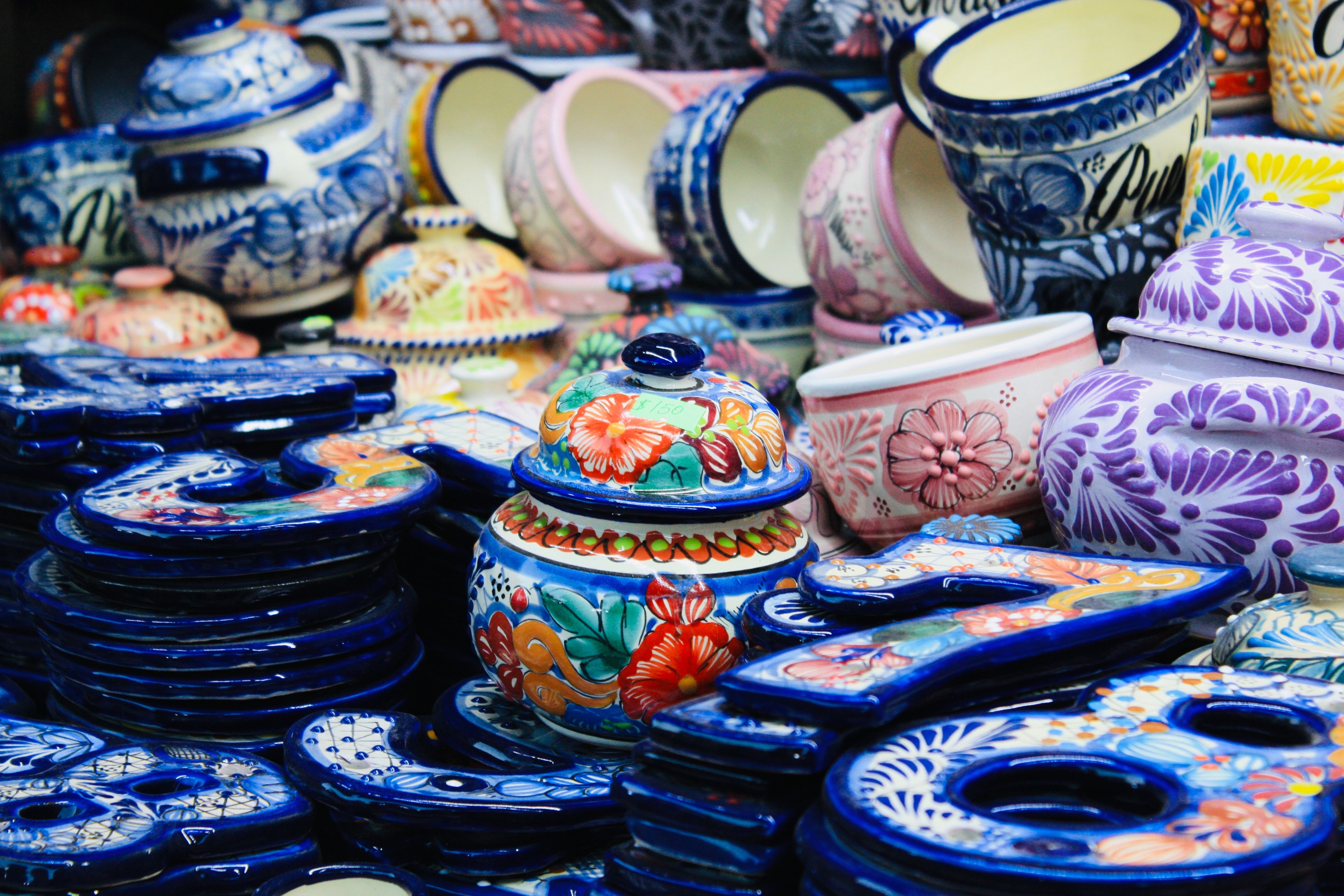
Talavera's iconic look emerged from a rare convergence of three cultural worlds — European, indigenous Mesoamerican, and Asian — meeting in colonial Puebla. Spanish and Italian ceramic traditions introduced the white tin-enamel base, a technique known in Europe as maiolica. Indigenous artisans contributed local clay knowledge and motifs rooted in pre-Columbian visual culture. Meanwhile, Chinese porcelain designs arrived via the Manila Galleon trade route, lending the cobalt blue patterns and floral arrangements so recognizable in classic Puebla pottery today.
This cultural layering shows up in the variety of patterns workshops still use: geometric, Islamic-influenced borders; flowing Ming-dynasty-style florals; and native fauna rendered in rich mineral pigments. The result is a visual language unique to Mexico — one that no single culture could have produced alone.
How is authentic Talavera actually made?
Authentic Mexican Talavera pottery follows a precise, labor-intensive production process that has remained essentially unchanged since the 16th century. Under the 1998 NOM-132-SCFI standard, production must be entirely manual and artisanal, using characteristic local raw materials from designated regions.
The process unfolds in several distinct stages:
1. Clay preparation — White and black clays are mixed to improve plasticity and structural strength, then cleaned and aged.
2. Forming — Pieces are shaped by hand or on a traditional wheel, then left to dry slowly.
3. First firing (bisque) — The dried forms are fired in a kiln to harden them before decoration begins.
4. Decoration — Master artisans apply enamel pigments freehand onto the unfired glaze surface, a skill requiring years of practice.
5. Glazing — The opaque white tin glaze is applied as a vivid base coat.
6. Second firing — A final kiln firing at around 1,050°C fuses glaze and decoration permanently into the surface.
No molds for surface design, no machine printing, no shortcuts. The oral transmission of this knowledge — from experienced potters to the next generation — is itself part of what UNESCO recognized as culturally significant.
|
Production Stage |
Method |
Key Material |
|
Clay preparation |
Hand-mixed and aged |
White and black local clays |
|
Forming |
Wheel or hand-built |
Prepared clay body |
|
First firing |
Kiln bisque fire |
Raw earthenware |
|
Decoration |
Freehand enamel painting |
Mineral-based pigments |
|
Final firing |
Kiln at ~1,050°C |
Tin-enamel glaze |
How does Talavera appear in Mexican architecture and daily life?
Talavera ceramics are not confined to shelves and market stalls — they are literally built into Mexico's architectural heritage. In Puebla's city center, a UNESCO World Heritage site, the petatillo tile façade designs of historic buildings represent one of the craft's most striking large-scale uses. Churches, colonial mansions, and public fountains across Puebla feature hand-painted Talavera tiles as structural decoration, integrating artisanal craft into the urban landscape in a way few traditions have achieved.
In domestic life, Talavera appears as tableware, jars, bowls, flowerpots, candleholders, and decorative plates — objects common in colonial homes that remain widely used in Mexican households today. The craft shapes daily rituals as much as it shapes skylines.
[IMAGE | Alt: Historic Puebla building facade covered in colorful hand-painted Talavera ceramic tiles | Caption: Talavera tile facades are a defining feature of Puebla's colonial architecture and UNESCO World Heritage cityscape.]
How do artisans and institutions protect Talavera's authenticity today?
A Denomination of Origin protects authentic Puebla pottery, granted in 1997 and covering production districts in Puebla—including Atlixco, Cholula, Tecali, and Puebla city—later extended to San Pablo del Monte in Tlaxcala. This designation legally restricts the name "Talavera" to pieces produced manually in these areas using specific local materials, distinguishing genuine craft from imitations.
UNESCO's 2019 inscription of the Talavera crafting process as Intangible Cultural Heritage of Humanity — shared with the Talavera tradition of Talavera de la Reina and El Puente del Arzobispo in Spain — further elevated global awareness of the tradition's fragility and value. Workshops like Uriarte Talavera, founded in Puebla in 1824, have played a critical role in keeping the craft commercially viable while maintaining historical motifs drawn from pre-Columbian, Islamic, Chinese, and Italian decorative sources.
[IMAGE | Alt: Shelves of certified authentic Talavera pottery pieces including plates, bowls,s and vases in a Puebla workshop | Caption: Certified Talavera workshops in Puebla produce pieces that meet strict Denomination of Origin standards for authenticity.]
Why does Talavera matter during Hispanic Heritage Month?
Mexican cultural heritage finds one of its most tangible expressions in Talavera ceramics, making the craft especially meaningful during Hispanic Heritage Month. Preserving regional craftsmanship like Talavera is an act of cultural resistance — it keeps communities connected to the hands, knowledge, and aesthetic values of their ancestors at a time when globalized mass production threatens artisanal traditions worldwide.
For Mexican-Americans, Talavera carries emotional weight beyond decoration. A hand-painted tile in a kitchen, a ceramic bowl passed between generations, or a brightly colored pot on an apartment windowsill can serve as a daily, tactile connection to Puebla's streets and to the people who shaped them. Just as papel picado carries deep symbolic meaning through Mexican celebrations, Talavera transforms everyday objects into acts of cultural memory — beauty that holds history inside it.
Can a painted ceramic really carry a culture forward?
Mexican Talavera pottery demonstrates that craft is never just decoration. From the mixed-clay workshops of Puebla to the tiled facades of a UNESCO World Heritage cityscape, every hand-painted piece carries five centuries of shared knowledge, cross-cultural exchange, and artisanal pride. The fact that production methods remain essentially unchanged since the 16th century—and are still transmitted orally from master to apprentice—shows how deliberately communities protect what matters most.
For the Mexican-American diaspora, supporting Talavera means more than buying beautiful objects. It means sustaining living artisans, honoring regional identity, and keeping Puebla's visual language alive in homes far from Mexico. During Hispanic Heritage Month and beyond, choosing authentic, certified Talavera over imitations is a small but meaningful act of cultural solidarity.
Explore the Mexican community on United Tribes—discover artisans, cultural businesses, and heritage stories that connect the diaspora to traditions worth preserving.
Frequently Asked Questions
What is the difference between authentic Talavera and imitation Talavera?
Authentic Talavera is produced entirely by hand using local clays from designated districts in Puebla and Tlaxcala, protected by a Denomination of Origin granted in 1997. Imitation pieces are often machine-made or produced outside these regions and lack the legal right to carry the Talavera name.
Which colors are traditionally used in Talavera pottery?
Traditional Talavera pottery uses a palette of six signature colors: cobalt blue, yellow, black, green, orange-red, and mauve — all derived from mineral pigments. Cobalt blue is the most iconic, inspired in part by Chinese porcelain brought to Mexico via Manila Galleon trade routes.
How long does it take to make a single piece of Talavera?
An authentic piece of Talavera can take several weeks to complete. The process includes clay aging, drying time between stages, freehand painting, and two separate kiln firings — each requiring careful timing and skilled oversight by experienced artisans.
Where can Mexican-Americans find authentic Talavera in the United States?
Authentic Talavera pieces certified under Mexico's Denomination of Origin can be found at specialty Mexican artisan shops, cultural markets, and heritage festivals across the United States. Buyers should look for official certification marks to confirm a piece meets the handmade, regionally sourced production standards.
What types of objects are traditionally made in Talavera style?
Talavera artisans produce a wide range of objects, including tableware, decorative plates, jars, bowls, flowerpots, tiles, candleholders, and serving pieces called fruteros. Tiles are among the most architecturally significant products, historically used to decorate colonial buildings, church facades, and fountains across Puebla.
Is Talavera pottery still produced the same way it was in the 16th century?
Yes — the core production process for authentic Talavera pottery has remained essentially unchanged since the colonial era. Clay preparation, hand-forming, freehand decoration, and double-kiln firing are still done by hand, and master potters pass the knowledge down orally to the next generation of artisans.
Make United Tribes Your Preferred Source
Add United Tribes on Google to get the latest stories, cultural updates, and community events directly in your Google Search and Top Stories.