

Key Takeaways
- La Catrina began as political satire. José Guadalupe Posada created the original zinc etching around 1912 to mock lower-class Mexicans who abandoned their Indigenous heritage to imitate European aristocratic fashion.
- Diego Rivera gave La Catrina her iconic full form. Rivera's 1946–47 mural *Dream of a Sunday Afternoon in the Alameda Central* transformed Posada's bare skeletal bust into a fully dressed, elegantly gowned national symbol.

Welcome to United Tribes
Where Mexican Culture Comes Alive
Join Your Tribe
Connect with your people
Discover Events
Watch parties & festivals
Find Mexican Businesses
Restaurants, markets & more
Earn Crown Credits
Get rewarded for engaging
- The name "Catrina" originated with Rivera, not Posada. Posada called his original image *La Calavera Garbancera*; Rivera's mural renamed and reimagined her, cementing her modern identity.
- La Catrina embodies a universal message about mortality. Her imagery argues that death erases all class distinctions, making wealth and social status ultimately meaningless — a message rooted in the Porfiriato era.
- La Catrina now appears across art forms and celebrations. Ceramic sculptures, papier-mâché figures, sugar artistry, and costumed enactments fill late-October and early-November Día de los Muertos festivities across Mexico and the U.S.
Few images in Mexican art history carry as much weight as a skeleton in a feathered hat. La Catrina began as a sharp political cartoon and grew into one of the most recognized symbols of Mexican cultural identity — a figure whose elegance and wit still resonate more than a century after her creation.
What is the origin and meaning of La Catrina?
La Catrina originated as a zinc etching by Mexican printmaker José Guadalupe Posada, created around 1912 and published posthumously in a 1913 satirical broadside. She represents the equality of death—the idea that no amount of wealth, fashion, or social ambition can save anyone from mortality —a message Posada directed squarely at the aspirational elite of his era.
Posada's original image showed only a skeletal female bust wearing an extravagant European-style wide-brimmed hat adorned with ostrich plumes and flowers. He titled it *La Calavera Garbancera*—a mocking name for lower-class Mexicans who rejected their Indigenous roots to adopt the manners and fashions of European aristocracy. The skull beneath the finery made his point without a single word.
The historical context matters here. Posada was working during the Porfiriato, the long reign of President Porfirio Díaz, when Mexico's ruling class enthusiastically adopted European culture as a marker of sophistication and progress. Indigenous identity was treated as something to be overcome. Posada's skeleton in European finery was a direct rebuke: death strips away every pretension, leaving all people — aristocrat and peasant alike — equally bare.
Diego Rivera Transformed Catrina Into a National Icon
Diego Rivera gave La Catrina her name, her body, and her place in the national imagination. In his sweeping 1946–47 mural *Dream of a Sunday Afternoon in the Alameda Central*, Rivera took Posada's skeletal bust and gave her a full figure dressed in a sumptuous gown and feather boa, positioning her as a central presence among dozens of historical Mexican figures.
Rivera's artistic choices were deliberate and layered. He placed Posada beside Catrina. He painted a young Rivera holding her hand, symbolically framing her as a creative muse connecting generations of Mexican artists. He also wove indigenous motifs into the mural — including a representation of Quetzalcoatl — reinforcing that Mexican identity was rooted in pre-colonial civilization, not European imitation. Catrina, draped in Old World elegance but rendered as a skeleton, stood as the mural's ironic centerpiece.
|
Element |
Posada's Original (c. 1912) |
Rivera's Mural (1946–47) |
|
Form |
Skeletal bust only |
Full-bodied, gowned figure |
|
Name |
La Calavera Garbancera |
La Catrina |
|
Hat |
Wide-brimmed, European plumes |
Retained and elaborated |
|
Setting |
Satirical broadside print |
Grand public mural |
|
Symbolism |
Class mockery |
National cultural identity |
Rivera's version lodged itself in collective memory. The name "Catrina" — drawn from a slang term for an overdressed dandy — became the image's permanent identity, and the fully realized female skeleton became a canvas for artistic interpretation across Mexico and, eventually, the world.
La Catrina's Dual Role as Satire and Celebration
La Catrina carries two simultaneous meanings that have coexisted since her earliest appearances. On one level, she critiques — a reminder that class pretension is cosmetic and temporary. On another, she celebrates the Mexican cultural relationship with death, with pre-colonial roots in traditions that treated mortality not with dread but with familiarity.
This duality made her a natural fit for Día de los Muertos, the late-October and early-November observance in which families honor deceased relatives with altars, marigolds, food, and remembrance. La Catrina does not belong exclusively to that holiday — she predates its modern form — but her imagery aligns perfectly with its spirit. She is death made beautiful, made witty, made worthy of celebration rather than fear. Just as papel picado brings color and craft to Día de los Muertos altars, La Catrina brings a visual philosophy: that honoring the dead is an act of joy, not grief.
La Catrina's Influence on Mexican Art and Fashion
La Catrina has become one of the most reproduced figures in Mexican visual culture, inspiring artists working across an extraordinary range of media. Ceramic sculptors, papier-mâché artisans, painters, muralists, and textile designers have all worked with her image, each reinterpreting her elaborate silhouette through their own cultural lens.
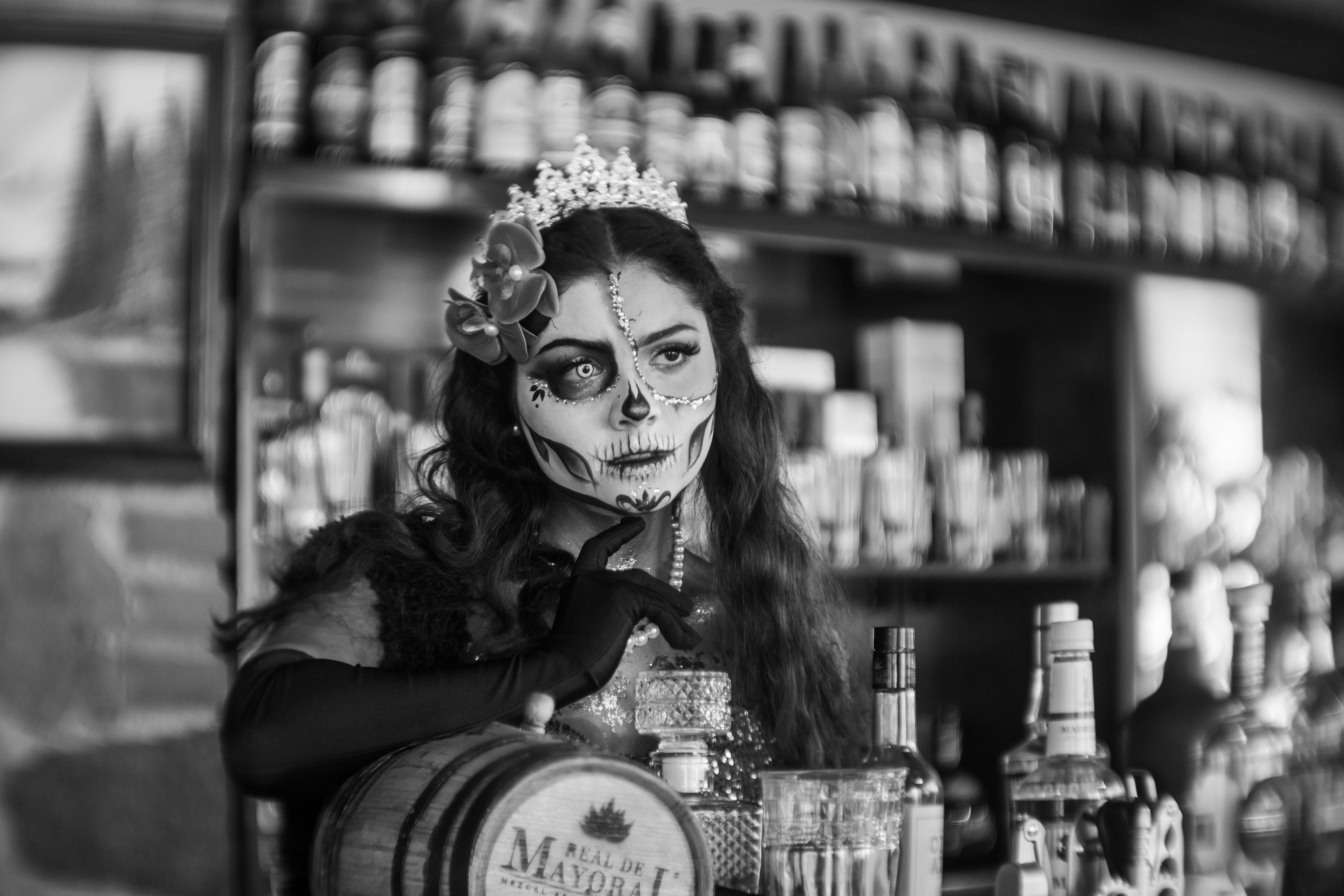
Her influence on Mexican fashion is equally significant. The face paint associated with Catrina costuming — intricate skull designs that echo her skeletal features while incorporating flowers, color, and personal style — has become a major expressive tradition during late-October celebrations. People do not simply dress as La Catrina; they interpret her, adding contemporary elements while honoring the visual language Posada and Rivera established.
This creative tradition extends into the kitchen. Bakers craft Catrina-shaped sugar figures, and her imagery appears alongside pan de muerto and other ceremonial foods as part of ofrenda displays. The skeleton has become a design language shared across art, food, fashion, and community celebration.
La Catrina in the Mexican-American Community
In the United States, La Catrina has become a touchstone for Mexican-American identity and cultural pride. Community festivals from Los Angeles to Chicago feature elaborate Catrina processions, face-painting booths, and altar installations that center her image as a declaration of heritage rather than a Halloween novelty.
For diaspora communities, La Catrina represents something beyond a festival costume. She is a visual assertion of cultural continuity — a way of saying that Mexican identity, with its complex history of Indigenous roots, colonial experience, and artistic resistance, travels across borders and generations. In a country where that identity is sometimes reduced to stereotypes, La Catrina's sophistication, her irony, and her elegance make her a quietly powerful cultural statement.
La Catrina's Legacy Lives On in Every Generation
From a zinc etching made to mock class pretension to a fully realized national icon reimagined by one of Mexico's greatest muralists, La Catrina's journey through Mexican art history is one of the most compelling transformations in visual culture. She began as Posada's sharp political commentary on the Porfiriato era and became something larger — a symbol of Mexican identity that holds together humor, beauty, Indigenous pride, and a philosophical acceptance of mortality.
For Mexican and Mexican-American communities, La Catrina is more than a decorative figure that appears in late October. She reminds us that cultural memory persists, that art can carry critique and celebration at once, and that traditions passed down through generations—in murals, ceramic workshops, ofrenda altars, and face paint applied before a community procession—are worth protecting and sharing.
Explore the stories, businesses, and cultural voices behind the Mexican community and so many others at United Tribes, where heritage finds its digital home.
Frequently Asked Questions
Who created La Catrina originally?
La Catrina was created by Mexican printmaker José Guadalupe Posada around 1912. He titled the zinc etching *La Calavera Garbancera* as a satirical critique of Mexicans who abandoned their Indigenous heritage to imitate European aristocratic fashion. Diego Rivera later renamed and expanded the figure.
Why did Posada call his etching La Calavera Garbancera?
"Garbancera" was a derogatory slang term for lower-class Mexicans who rejected their Indigenous identity to appear more European and socially elevated. Posada used the term mockingly, pairing it with a skull to emphasize that no social performance survives death. The name reflected the era's sharp political satire.
How did La Catrina become associated with Día de los Muertos?
La Catrina became associated with Día de los Muertos because her imagery aligns naturally with the holiday's philosophy of honoring death without fear. Though she predates the holiday's modern form, her combination of elegance and skeletal imagery made her an intuitive visual representative of the celebration's spirit of joyful remembrance.
Is La Catrina a traditional pre-colonial Mexican figure?
La Catrina is not a pre-colonial figure — she was created in the early twentieth century by Posada. However, she draws on deep Mexican cultural traditions of representing death in a non-fearful, even festive way, which do have pre-colonial roots in Mesoamerican ritual life and cosmology.
What materials are typically used to make La Catrina art figures?
La Catrina figures are produced in a wide range of traditional craft materials, including ceramic, papier-mâché, and sugar. Artisans across Mexico and the U.S. create these pieces for ofrenda displays, festival markets, and home altars, with each medium allowing for distinct stylistic interpretations of her iconic silhouette.
How has La Catrina's appearance changed from Posada's original to modern versions?
Posada's original depicted only a skeletal bust with a European-style feathered hat. Diego Rivera added a full body, gown, and feather boa in his 1946–47 mural, establishing the silhouette recognized today. Modern interpretations further expand her image with elaborate face paint, colorful florals, and regionally distinct costume elements.
Make United Tribes Your Preferred Source
Add United Tribes on Google to get the latest stories, cultural updates, and community events directly in your Google Search and Top Stories.