
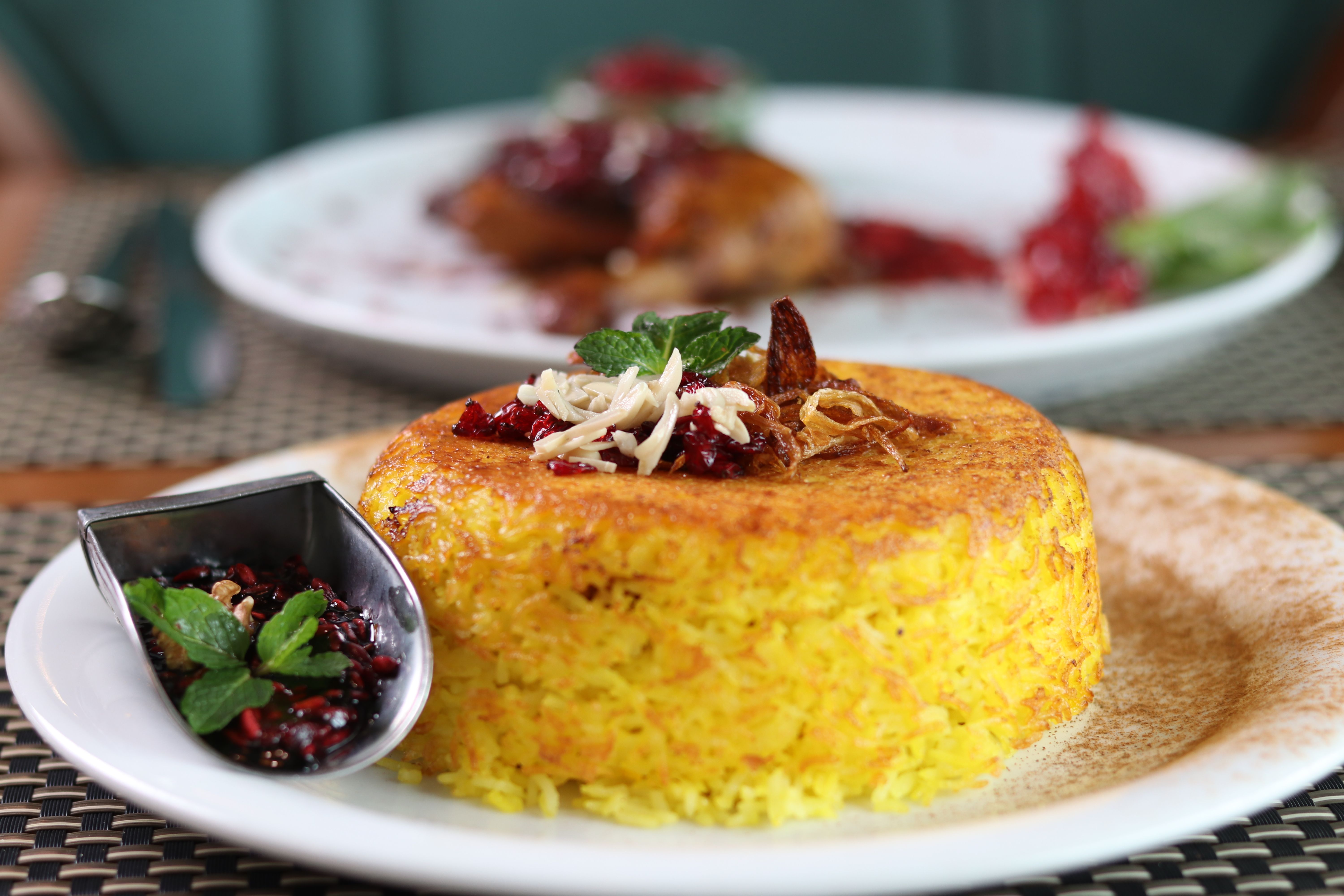

The Dish That Stops the Conversation
There is a moment in many Persian households that everyone at the table recognizes. The pot is flipped. A sharp intake of breath follows. Then, if the timing and technique came together just right, the golden crust of tahdig releases in one clean, satisfying round — and the room erupts. No announcement needed. No ceremony required. The crispy rice speaks for itself.

Welcome to United Tribes
Where Persian Culture Comes Alive
Join Your Tribe
Connect with your people
Discover Events
Watch parties & festivals
Find Persian Businesses
Restaurants, markets & more
Earn Crown Credits
Get rewarded for engaging
Tahdig, which translates roughly to "bottom of the pot," is one of the most iconic elements of Iranian cuisine. It is the caramelized, crackling layer of rice that forms against the base of the cooking vessel, and it has inspired a kind of reverence in Persian food culture that few dishes can match. Understanding why requires understanding what food means in an Iranian home.
How the Crust Forms
The creation of tahdig emerges from a deliberate combination of heat, fat, and time. Rice is parboiled, drained, and then returned to the pot with oil or butter coating the bottom. As the pot heats, that bottom layer of rice begins to fry gently against the surface while the rest steams above it, wrapped in a kitchen towel or cloth placed beneath the lid to absorb moisture.
The result is a dual-textured achievement. The upper rice is fluffy and fragrant. The bottom layer transforms into something entirely different — a dense, golden, crackling crust with a depth of flavor that the softer grains above cannot replicate. That contrast is the whole point. Persian cooking techniques have been refined across centuries, and tahdig is one of the clearest expressions of that mastery.
The Variations That Make It Personal
Tahdig is not one thing. Across Iranian households and regions, the crispy base takes on different forms depending on what is layered at the bottom of the pot. Plain rice tahdig is the most common, producing a pure golden crust. But cooks often press flatbread — typically lavash — against the oiled base before adding rice, creating a thinner, crispier result with a slightly different chew.
Potato slices are another popular variation, arranged in an overlapping layer that crisps into golden rounds with soft interiors. Some cooks use tomatoes, herbs, or saffron-stained rice packed against the base for color and complexity. Each variation carries the identity of the cook who made it. Grandmothers have their preferred method. Aunts defend their technique. The version you grew up with becomes, in some sense, the standard against which all others are measured.
The depth of Persian food culture is evident in the variation within a single dish — and in how passionately each family holds to their own approach.
Whose Piece Do You Get
The sociology of tahdig distribution matters. At a Persian family meal, who receives the crispy bottom is never quite random. The most coveted pieces — the fully golden, structurally intact sections — tend to go to children, honored guests, or the eldest at the table. It is an act of care expressed through food. Offering someone a good piece of tahdig communicates warmth and priority without a single word.
Children who grow up in Iranian households often recall hovering near the kitchen when the pot flip was imminent. The anticipation was real. Getting a crispy corner piece felt like winning something. That emotional charge around a dish is how food becomes memory, and how memory becomes identity.
Tahdig and the Architecture of a Persian Meal
Persian family meals are rarely rushed affairs. Rice is central, but it shares the table with stews, herbs, pickles, and bread. The regional variety within Iranian cuisine means that what accompanies the tahdig varies by geography and family tradition — ghormeh sabzi in one home, fesenjan in another, a simple yogurt alongside it in a third.
Tahdig functions as both a side and a centerpiece. It is plated prominently, often placed where everyone can reach it. The crispy layer does not sit passively on the table. It gets pulled apart, competed for, and quietly rationed by whoever is serving. Its presence signals that someone cared enough to get it right.
Tahdig in the Diaspora Kitchen
For Persian-Americans, tahdig carries particular weight. It is one of the first dishes many in the diaspora attempt to recreate after leaving Iran or after growing up in households where it was a weekly fixture. The challenge is real: apartment stoves behave differently, pots vary, and the intuition built over years of watching a parent cook does not transfer automatically.
But the effort is the point. Making tahdig in a diaspora kitchen is an act of cultural continuity. It connects the cook to a lineage of family meals, to a specific smell, to a memory of a table. The wisdom embedded in Persian culinary tradition lives in the practiced knowledge passed down through generations, in kitchens far from its origins.
When tahdig succeeds in a diaspora home, the satisfaction is layered. It is culinary and emotional at once.
Why Non-Persian Tables Want It Too
Tahdig has found admirers well beyond the Persian community. Food writers, home cooks, and restaurant-goers who encounter it for the first time tend to respond with immediate enthusiasm. The appeal is straightforward: the texture contrast is extraordinary, and the flavor — rice that has been gently fried in butter or oil, sometimes kissed with saffron — is simple and profound at the same time.
Its rising visibility reflects a broader curiosity about Iranian cuisine that has been steadily growing. Persian food deserves discovery on its own terms as a deeply considered culinary tradition with its own logic, hierarchy of flavors, and emotional vocabulary.
Tahdig sits at the center of that vocabulary. It is the dish that reminds a diaspora family of home and introduces a first-time guest to what Persian cooking is really about.
The Crust Worth Gathering Around
Tahdig is a weekly ritual in millions of Iranian households and a touchstone for Persian-Americans navigating the distance between where they come from and where they live now. Its different forms, its distribution at the table, and the anticipation surrounding its arrival all speak to how food carries meaning far beyond nutrition.
What makes tahdig enduring is its honesty. It requires no rare ingredients. It rewards patience, attention, and practice, the same qualities that define thoughtful cooking everywhere. That simplicity, combined with the emotional weight it carries in Persian family meals, is precisely why it resonates so widely.
Persian home cooks, restaurateurs, and food storytellers sharing Iranian food culture across the U.S. are part of a larger community keeping these traditions visible and alive — connect with them on United Tribes and discover what else this community is building.
Make United Tribes Your Preferred Source
Add United Tribes on Google to get the latest stories, cultural updates, and community events directly in your Google Search and Top Stories.


