
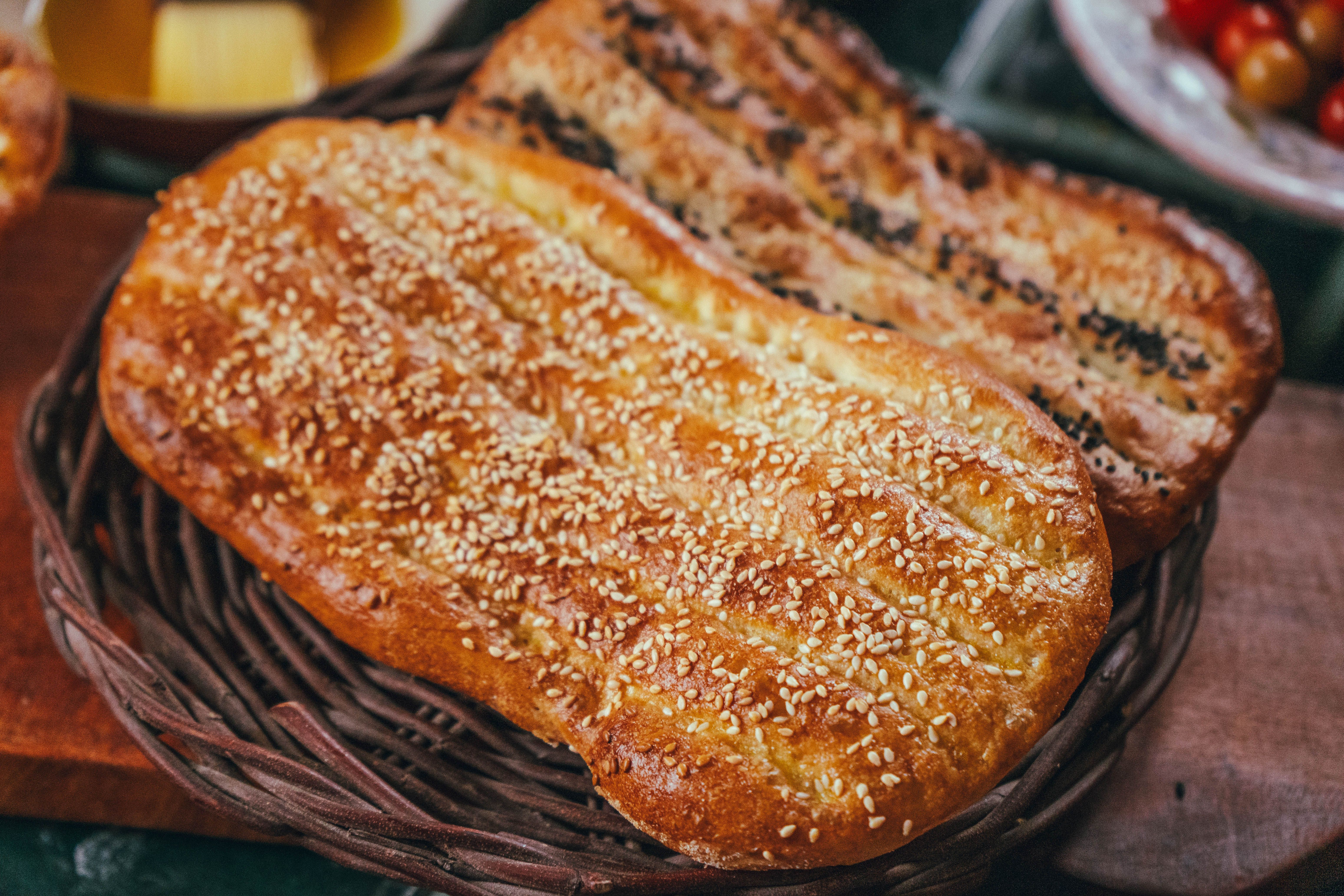

Few things in Persian cuisine carry the weight that bread does. In Iranian households, bread is the foundation of the meal. Persian bread varieties like sangak, barbari, taftoon, and lavash each have their own texture, history, and purpose. For the Iranian-American community, they remain among the most tangible threads connecting daily life to a homeland thousands of miles away.
Sangak: The Ancient Stone-Baked Loaf
Sangak is perhaps the most celebrated of all Persian breads. Its name literally means "little stone" in Farsi, a nod to its traditional preparation: the dough is stretched and baked directly on a bed of river pebbles inside a tandoor-style oven. The result is a large, irregular flatbread with a dimpled surface, a chewy interior, and a slightly crisp, golden exterior.

Welcome to United Tribes
Where Persian Culture Comes Alive
Join Your Tribe
Connect with your people
Discover Events
Watch parties & festivals
Find Persian Businesses
Restaurants, markets & more
Earn Crown Credits
Get rewarded for engaging
What sets sangak apart is its leavened whole-wheat dough, which gives it a nutty depth that pairs beautifully with Iranian food staples like feta cheese, fresh herbs, and walnuts for breakfast. It also serves as the ideal companion to slow-cooked stews and kebabs at dinner. A freshly baked sangak, still warm and folded over itself in a paper wrapper, is one of the most iconic images of an Iranian morning.
In Iran, buying sangak from the neighborhood bakery is a daily ritual. The bread is sold by weight, and bakers work in full view of their customers — a performance of craft that builds trust and community simultaneously.
Barbari: Bold, Thick, and Built for Toppings
If sangak is elegant in its simplicity, barbari bread is generous and assertive. Thick, oval-shaped, and scored lengthwise with deep ridges, barbari has a glossy crust — achieved by brushing the surface with a starchy glaze called "roomal" before baking — and a pillowy, airy interior. It is substantial enough to withstand toppings and dips without losing its structure.
Barbari is a traditional breakfast bread by tradition. Torn and dipped into clotted cream (*kaymak*) and honey, or layered with butter and jam alongside a glass of hot tea, it transforms the morning meal into something unhurried and indulgent. This connection between barbari and the slower rhythms of Iranian mornings mirrors the broader role that Persian tea culture plays as a daily ritual in Iranian-American homes — both are about pausing, gathering, and savoring.
Taftoon: Thin, Fragrant, and Versatile
Taftoon occupies a quieter but equally important place in Persian cuisine. Thinner than barbari and slightly smaller than sangak, taftoon is a leavened flatbread traditionally baked against the inner wall of a clay oven. It often features a sprinkling of sesame or poppy seeds and carries a mild, slightly tangy flavor from its fermented dough.
Its versatility makes it a workhorse bread in everyday cooking. Taftoon wraps around grilled meats, scoops up thick herb stews, and serves as a base for the much-loved open-faced sandwich combinations common in Iranian street food. It is also one of the breads most commonly found at ceremonial tables, including the Nowruz *sofreh* (the Persian New Year spread), where bread symbolizes prosperity and abundance.
Lavash: The Thinnest Thread of Tradition
Lavash is the most internationally recognized of the four, partly because its paper-thin profile has made it adaptable across many cuisines. In Persian cuisine, lavash is unleavened and baked in seconds against the scorching wall of a stone or clay oven — emerging crackling and lightly charred at the edges.
Fresh lavash is soft and pliable, ideal for wrapping herbs, cheese, and walnuts into tight rolls (*sabzi khordan*). As it dries, it becomes brittle and is broken into pieces to accompany soups and stews. UNESCO recognized lavash in 2016 as an Intangible Cultural Heritage, acknowledging not just the bread itself but the communal act of making it: women gathering to stretch and slap the dough, bake in rotation, and share the results.
The Iranian Bakery as Community Anchor
In Iran, the neighborhood Iranian bakery — or *nānvāyi* — is a social institution. Bakeries typically specialize in one type of bread, and regulars build loyalty to a specific baker whose loaves they trust. The smell of fresh-baked bread drifting through a neighborhood signals morning has properly begun.
For Iranian-Americans, replicating this experience in the U.S. has driven real entrepreneurship. From Los Angeles's Westwood district — sometimes called "Tehrangeles" — to communities in the Bay Area, Dallas, and Washington, D.C., Persian bakeries have become anchors of cultural life. Iranian-American entrepreneurs building business and community often cite food — and bread in particular — as their entry point into both commerce and cultural preservation.
These bakeries don't just sell bread. They sell continuity. For second-generation Iranian-Americans navigating questions of cultural identity, walking into a Persian bakery and recognizing the smell, the language, and the rhythm of the place can be profoundly grounding. And as Persian cuisine continues influencing American dining, these traditional breads are increasingly appearing on non-Iranian menus — proof that the flavors are finding new audiences.
Bread, Heritage, and Belonging
Sangak, barbari, taftoon, and lavash each tell a different part of the Iranian story, and together they form a bread basket rich with meaning that has traveled with the diaspora across continents.
For Iranian-Americans, the search for a good loaf of barbari or a properly stone-baked sangak is also a search for connection — to family, to homeland, and to a culture that expresses love through food. Whether found at a neighborhood Persian bakery or baked at home from a grandmother's recipe, these breads remain one of the most delicious forms of cultural memory.
Explore the Iranian-American community, discover culturally rooted businesses, and connect with the traditions that make this heritage so vibrant by browsing the United Tribes community.
Make United Tribes Your Preferred Source
Add United Tribes on Google to get the latest stories, cultural updates, and community events directly in your Google Search and Top Stories.


