
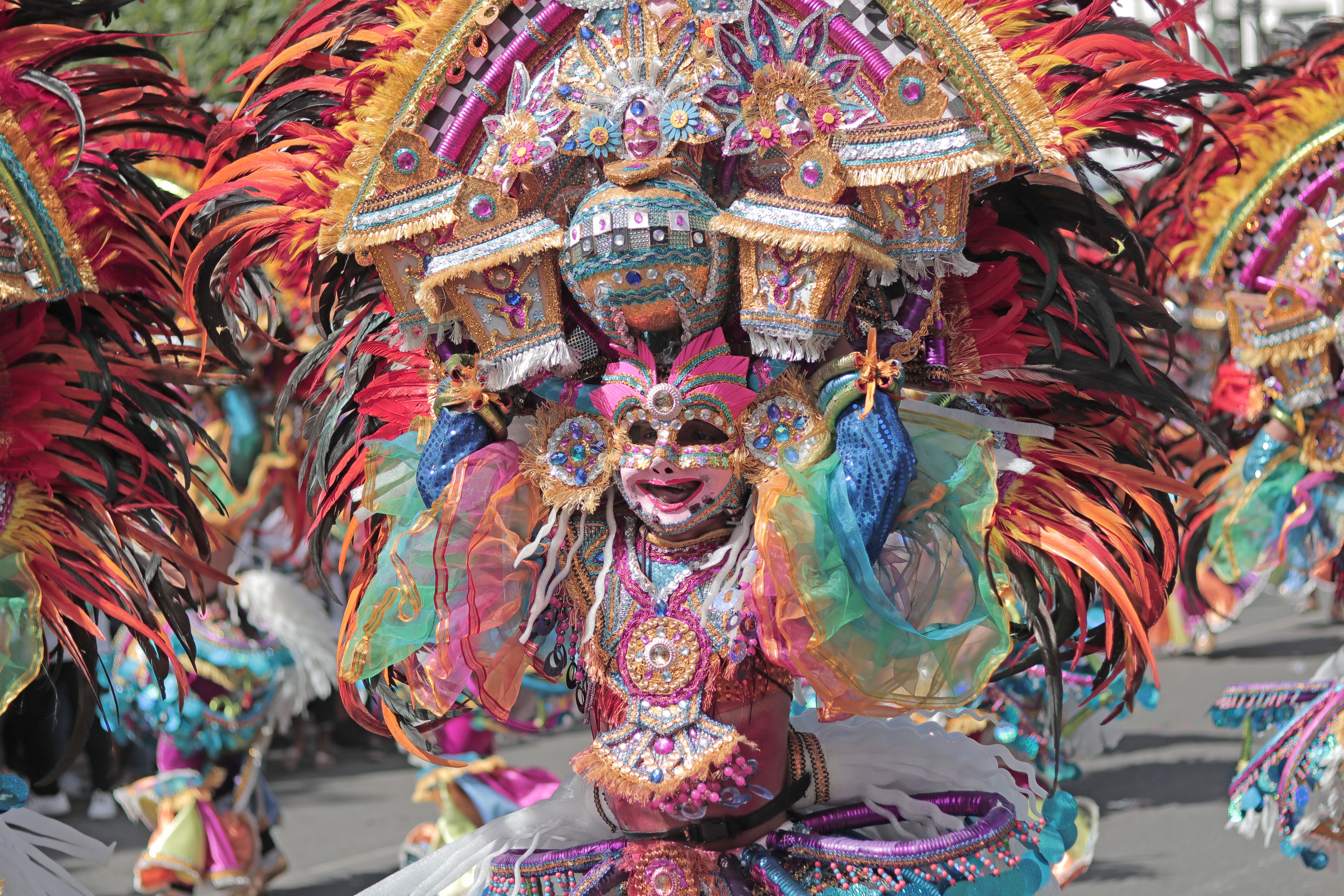

Every October, the city of Bacolod in the Philippines erupts in color, music, and movement — and at the center of it all is a smiling face. Not one face, but thousands of them, worn by dancers, street performers, and revelers who fill the city's streets with infectious energy. The MassKara Festival is one of Southeast Asia's most visually distinctive celebrations, and its beating heart is the mask. Understanding why those smiling masks became synonymous with Bacolod means understanding the city's history, its people, and what it means to choose joy in the face of hardship.
The Origin Story Behind the Smiling Face
The MassKara Festival was born in 1980, when Bacolod faced two devastating blows at once. The sugar industry — the economic backbone of the region — had collapsed, sending the local economy into crisis. Then, the MV Don Juan maritime disaster claimed hundreds of lives, many of them from Bacolod and the surrounding Negros Occidental province.

Welcome to United Tribes
Where Filipino Culture Comes Alive
Join Your Tribe
Connect with your people
Discover Events
Watch parties & festivals
Find Filipino Businesses
Restaurants, markets & more
Earn Crown Credits
Get rewarded for engaging
City leaders, artists, and community organizers faced a critical question: how do you lift a grieving, struggling city? Their answer was to celebrate anyway. The festival was deliberately designed as a public act of resilience, and the smiling mask became its defining symbol. MassKara is a portmanteau of the Filipino words *masa* (people or crowd) and *kara* (face), creating the phrase "many faces"—a fitting name for a city choosing to show its best face to the world.
What Makes the Masks Visually Distinctive
The MassKara masks are immediately recognizable. They are almost always depicted with an exaggerated, wide smile — bright, bold, and unmistakably joyful. Unlike solemn or ceremonial masks from other cultures, these are designed to radiate warmth and welcome.
Key visual characteristics include:
- Vivid color palettes — gold, yellow, red, and jewel tones dominate, often referencing the sugar cane fields that define Negros Occidental
- Decorative embellishments — sequins, beads, feathers, mirrors, and metallic accents catch stage and streetlight dramatically
- Stylized human features — wide eyes, arched brows, and that signature grin give each mask an almost theatrical expressiveness
- Headdresses and costumes — masks are rarely worn alone; they anchor elaborate full-body costumes that extend the visual drama upward and outward
Each mask is essentially a small work of art, crafted to stand out even in a sea of equally dazzling competitors.
The Art of Mask-Making
Behind every MassKara mask is a craftsperson, often working for weeks or months before the festival begins. Mask-making is a skill passed down through generations in Bacolod, and local artisans take enormous pride in their work.
The process typically involves:
1. Sculpting a base form from papier-mâché, fiberglass, or plaster molds
2. Sanding and sealing the surface to create a smooth painting ground
3. Applying base colors and detailed hand-painted designs
4. Attaching embellishments — this stage can take days for competition-level pieces
5. Fitting the mask to a wearer and integrating it with the costume and headdress
Competition masks are judged not just on aesthetics but on craftsmanship, structural integrity, and how well they move with the performer. The standard has risen every year, pushing artisans to innovate while honoring the festival's visual traditions.
Street Dancing and the Mask in Motion
The masks come fully alive during the MassKara Festival's street dancing competitions, the celebration's centerpiece. Contingents from schools, barangays (neighborhoods), and organizations spend months choreographing routines that integrate the masks into dynamic, high-energy performances.
What's striking is how expressive performers become despite — or perhaps because of — wearing a fixed smiling face. Movement becomes the language. Hip rolls, arm extensions, synchronized formations, and dramatic pauses all communicate emotion that the mask itself cannot show. The result is a paradox: a frozen smile that somehow conveys grief, pride, struggle, and triumph depending on the choreography surrounding it.
This relationship between stillness and motion is part of what makes Bacolod culture so distinctive within Filipino celebrations. Filipino festival traditions are rich and varied across the archipelago, but MassKara's particular vocabulary of masked performance is uniquely its own. For a broader look at how Filipino communities carry these traditions beyond the Philippines, the article on Filipino faith and festivals explores the devotional and communal threads that run through the culture year-round.
What the Mask Represents Today
Decades after its creation, the MassKara mask has evolved well beyond its origins as a symbol of crisis response. It now represents multiple overlapping meanings for Bacolod and its people.
For locals, it's civic identity — a visual shorthand for belonging to a city that chose resilience over despair. For visitors and tourists, it's an invitation into one of the most distinctive Filipino festivals on the calendar. For the Philippines Tourism Promotions Board, which lists MassKara among its featured October festivals, it represents the country's extraordinary capacity for cultural creativity.
The mask also carries economic weight. Artisans, costume designers, choreographers, and hospitality businesses all depend on the annual festival economy. Filipino-American communities in the U.S. have increasingly found ways to honor these traditions stateside—a phenomenon explored in depth in Bringing the Fiesta to the U.S., which examines how Filipinos adapt hometown celebrations to American contexts.
The MassKara Festival also appears in conversations about Filipino diaspora identity. For Negrenses living abroad, seeing the mask is an immediate emotional connection to home. Communities across the U.S. have incorporated MassKara-inspired imagery into Filipino festivals, keeping the smiling face visible far from Bacolod's streets.
The Smile That Defines a City
The MassKara mask is a philosophical statement made tangible. Bacolod looked at catastrophe and responded with craft, color, and community. That choice, repeated every October for over four decades, has transformed a single creative decision into a living cultural institution. The mask smiles because its city decided to, and that decision carries more weight than any single expression could hold.
For Filipino-Americans and Filipinos connected to the diaspora, MassKara represents something deeply resonant: the idea that cultural identity can be preserved and celebrated even when circumstances push hard against it. The festival's imagery — those sequined, wide-grinning faces — travels across oceans and still lands with full emotional force.
Curious about where Filipino cultural traditions are being celebrated near you right now? Explore the Filipino community on United Tribes to discover events, businesses, and stories rooted in heritage.
Make United Tribes Your Preferred Source
Add United Tribes on Google to get the latest stories, cultural updates, and community events directly in your Google Search and Top Stories.