
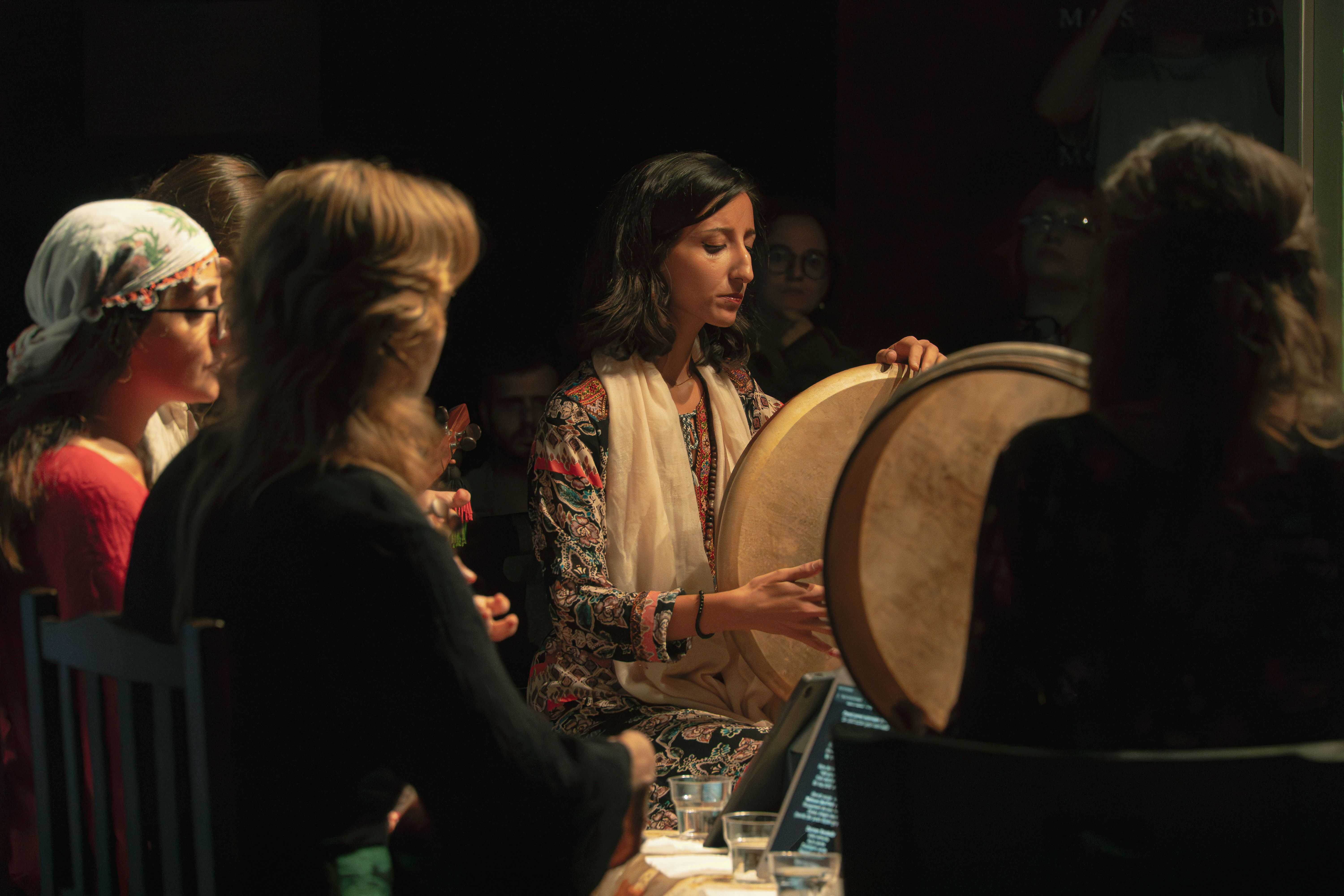

Some instruments carry sound; others carry meaning. The daf belongs firmly in the second category. This large frame drum holds centuries of spiritual weight, poetic tradition, and communal memory within its circular frame. For anyone exploring Persian musical culture, the daf is not a starting point—it is a center of gravity.
What the Daf Actually Is
The Persian daf is a frame drum, typically ranging from 40 to 60 centimeters in diameter. Its shallow wooden frame supports a thin animal-skin membrane, traditionally made from goat or fish skin, stretched taut across one side. What visually distinguishes the daf from other frame drums is the interior ring system: dozens of small metal rings or cymbals are attached around the inside of the frame. When the drum is struck, these rings vibrate and jingle at once, layering a shimmering metallic resonance over the membrane's deep bass. The result is a sound that is both grounded and ethereal—something felt as much as heard.

Welcome to United Tribes
Where Persian Culture Comes Alive
Join Your Tribe
Connect with your people
Discover Events
Watch parties & festivals
Find Persian Businesses
Restaurants, markets & more
Earn Crown Credits
Get rewarded for engaging
The instrument's construction requires significant craft. The wood must be lightweight yet resonant, the skin tensioned with precision, and the rings positioned to allow free movement without dampening the membrane's vibration. Different makers use varying ring sizes and densities to shift the instrument's tonal character, giving each daf a distinct voice.
Deep Roots in Persian History and Spirituality
The daf's origins stretch back over a thousand years within Persian and broader Middle Eastern cultures. Its earliest appearances in historical records link it closely to Sufi devotional practices, where it accompanied sama — the meditative music and movement ceremonies central to mystical Islam. Poets such as Rumi referenced the daf in verse, treating it as a symbol of the soul calling out for union with the divine.
This spiritual association fundamentally shaped how the daf drum was perceived for centuries. It was not simply a rhythmic instrument — it was a vehicle for transcendence. In many Sufi communities across Kurdistan, Iran, and parts of Turkey, the daf remains inseparable from ceremony and prayer. This context explains why learning the daf has traditionally carried a reverence beyond the musical, treating the drum as something to be approached with intention.
How the Daf Is Played
Performance technique on the daf is distinctive and physically demanding. The player holds the drum vertically in one or both hands, with fingers positioned along the outer frame. Strikes land using the fingers of the dominant hand, producing a range of tones depending on placement — center strikes generate deep bass tones, while edge strikes produce sharper, higher sounds.
Skilled daf players also use techniques that engage the rings directly—subtle wrist rotations, shakes, and controlled tilts cause the internal rings to cascade, creating textural effects between beats. The interplay between membrane strikes and ring movement defines the daf's rhythmic vocabulary. Mastering this balance demands years of study, and accomplished players can convey extraordinary dynamic range from delicate whispers to powerful, full-bodied rhythmic statements.
In ensemble settings, the daf typically anchors or decorates the rhythmic foundation beneath melodic Persian musical instruments like the tar, setar, kamancheh, and ney. Its role shifts with context—sometimes steady and cyclical, sometimes improvisational and expressive.
The Daf in Contemporary Iranian Music
By the late twentieth century, the daf had transitioned from primarily ceremonial contexts into mainstream Iranian music performance. Artists began incorporating it into concert stages, studio recordings, and cross-genre collaborations. Performers like Hossein Alizadeh brought serious compositional attention to the daf's place in Persian classical frameworks, helping elevate its profile among younger musicians.
Today, the instrument appears across a remarkable range of Iranian music styles — classical Persian repertoire, folk traditions from Kurdish and Azerbaijani regions within Iran, and contemporary fusion projects that blend Persian rhythmic structures with jazz, world music, and electronic production. This breadth reflects the daf's adaptability without eroding its cultural specificity.
For a broader look at how Persian instruments navigate tradition and modernity together, this exploration of Persian musical instruments and their enduring legacy offers valuable context. The revival of ancient Persian melodies in modern sounds further illustrates how instruments like the daf anchor that ongoing conversation.
Diaspora Musicians Keeping the Daf Alive
Iranian-American musicians have become essential stewards of the daf's presence outside Iran. In cities like Los Angeles, New York, Chicago, and Houston — home to significant Iranian-American populations — daf players perform at cultural festivals, teach community workshops, and record albums that reach audiences far beyond the diaspora. These musicians navigate a meaningful tension: honoring the instrument's ceremonial origins while making it accessible and visible in new environments.
This diaspora role extends to pedagogy. Iranian-American music teachers are increasingly incorporating the daf into structured curricula, introducing second-generation Iranian-Americans and curious students of all backgrounds to Persian music culture through hands-on experience. The instrument's dramatic visual presence and distinctive sound make it a powerful ambassador.
The Daf's Resonance Reaches Every Listener
The daf drum reminds us that percussion can carry poetry, that rhythm can be sacred, and that a single instrument can hold an entire civilization's emotional vocabulary. From Sufi ceremony to contemporary concert hall to diaspora community workshop, the daf has traveled without losing itself—remaining distinctly, powerfully Persian in every context it enters.
For Iranian-Americans and newcomers to Persian music culture alike, engaging with the daf is an entry point into something much larger: a tradition of sound that has always been about belonging, memory, and the human need to make meaning through music.
Explore the full richness of the Iranian-American community — its musicians, businesses, and cultural voices — at United Tribes, where Persian heritage and diaspora stories come alive.
Make United Tribes Your Preferred Source
Add United Tribes on Google to get the latest stories, cultural updates, and community events directly in your Google Search and Top Stories.


