
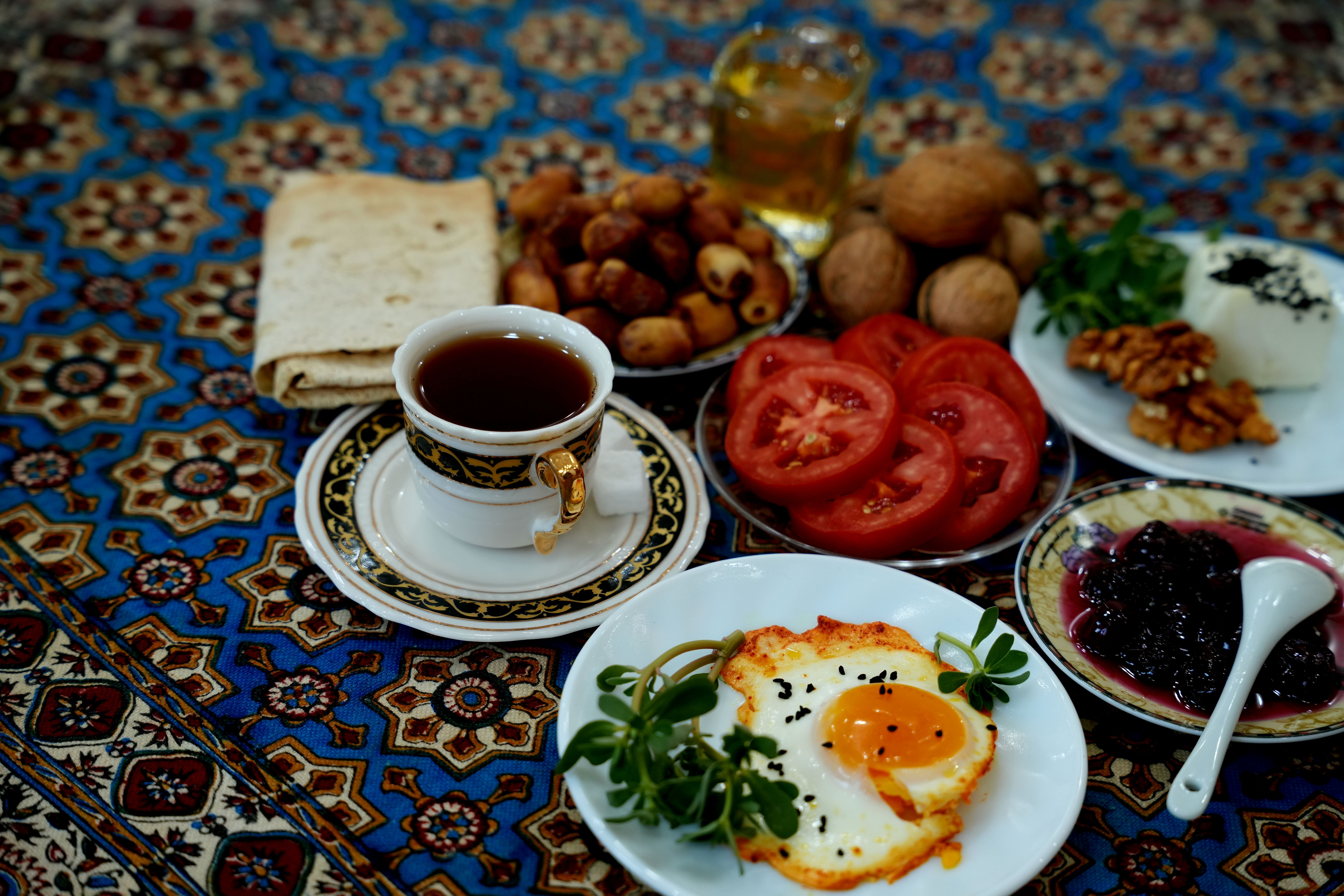

There is a particular kind of morning quiet that belongs to a Persian breakfast table. No hurrying, no eating standing over the sink. The table is set with intention — a basket of warm bread, small dishes of white cheese and fresh herbs, a jar of jam, a bowl of walnuts, perhaps a soft-boiled egg — and at the center, always, a pot of tea. Persian breakfasts are daily acts of care that Iranian families have carried across borders and generations.
The Architecture of the Table
A traditional Iranian breakfast is built from components rather than a single dish, which is part of what makes it so adaptable. Each item holds its own place, and the combination is left to the individual. Bread is the foundation — most commonly sangak, a long flatbread baked on hot river stones, or lavash, the thin, crackly sheet bread found throughout Iranian bakeries. Barbari, with its thick, chewy crumb and sesame-topped crust, is another beloved choice, especially in northern regions.

Welcome to United Tribes
Where Persian Culture Comes Alive
Join Your Tribe
Connect with your people
Discover Events
Watch parties & festivals
Find Persian Businesses
Restaurants, markets & more
Earn Crown Credits
Get rewarded for engaging
Around the bread, the table fills. Feta-style white cheese (*panir*) is nearly universal, eaten plain or paired with herbs. A plate of fresh greens — typically sabzi khordan — brings together mint, basil, tarragon, radishes, and spring onions. Walnuts, honey, and fruit preserves round out the spread. The result is a table that feels abundant without being heavy, varied without being complicated.
Regional and Household Variations
No two Persian breakfast tables are identical. In Azerbaijan and the northwest, it is common to find *kaymak* — a rich clotted cream — served alongside honey and fresh bread. Families in Gilan and the Caspian coast might add olives or a smear of zeytoon parvardeh, an olive paste made with pomegranate and walnuts. In urban Tehran households, the morning spread might be simpler: bread, cheese, jam, and butter alongside tea, echoing the pace of modern city life.
Eggs appear in many forms depending on the household. Nimroo — a fried egg cooked gently in butter — is a common weekday option. On slower mornings or weekends, families might prepare an omelet with tomatoes and onions, or halim — a slow-cooked wheat-and-meat porridge — which blurs the line between breakfast and a ritual occasion.
The Values Behind the Meal
What separates Persian food culture from a simple catalog of ingredients is the set of values the meal embodies. Freshness is always the priority: bread is ideally bought the morning of, herbs are crisp, and cheese is kept cold until the moment it is served. The idea of eating yesterday's bread or wilted greens would feel like a small failure of hospitality. Persian hospitality, rooted in the concept of taarof, insists that even an ordinary morning deserves effort and generosity.
Simplicity is equally central. Unlike elaborate brunch cultures, Iranian breakfast traditions rely on quality and combination rather than technique. The cook's task is to source well and arrange thoughtfully, not to transform. This approach reflects a broader sensibility in Persian cooking — that the best ingredients need little interference.
Tea as the Heart of the Morning
If bread is the foundation, tea is the soul. Persian tea culture centers on a specific ritual: black tea brewed strong in a small teapot, then diluted to taste with hot water from a larger pot. It is served in estakan — small, slender glass cups that show off the amber color — and sweetened by placing a sugar cube between the teeth and drinking the tea through it.
Tea is never rushed. It is refilled, discussed, and returned. The role of tea in Iranian-American homes extends well beyond breakfast — it marks every visit, every conversation, every beginning and ending — but morning is where the ritual is most quietly powerful. To drink tea before speaking of the day's obligations is an act of presence, a small insistence on stillness.
Recreating the Morning Table in America
For Iranian families living in the United States, Persian breakfast becomes both a comfort and a form of cultural preservation. The early challenge is sourcing — sangak and barbari require Iranian bakeries, which are found in cities with established Persian communities such as Los Angeles, Washington, D.C., Dallas, and Chicago. Sabzi khordan herbs are found at Persian grocery stores or Middle Eastern markets, and panir is increasingly available at international supermarkets.
For many families, weekend mornings become the time to rebuild the full spread. Children who grew up eating toast and cereal during the week might sit down on Saturday to a table that looks like their grandparents' kitchen in Tehran or Isfahan. Food becomes the bridge between generations, between memory and present life, between the country left behind and the one being built. The act of setting out the cheese, washing the herbs, and brewing the tea is itself a kind of homecoming — a way of saying that even here, even now, this is how we begin our day.
The ritual also travels. Iranian-American families visiting relatives, hosting friends, or gathering for cultural events often anchor the morning with these same elements. It is not nostalgia so much as continuity, a daily practice that connects the community to its roots while adapting naturally to life in a new place.
A Morning Table Worth Preserving
The Persian breakfast table is a quiet declaration of values: that mornings deserve care, that sharing food is a form of love, and that freshness and simplicity can be their own kind of abundance. From the crisp herbs to the amber tea poured into glass cups, every element has meaning — and together they create something greater than the sum of its parts. Iranian breakfast traditions have endured across migration and generations precisely because they are both deeply personal and infinitely adaptable.
For Iranian families in America, recreating these mornings is as much an act of identity as it is of nourishment. Whether it is a full weekend spread with barbari and kaymak, or a weekday cup of tea with bread and cheese before work, the ritual holds. It carries forward something essential about Persian food culture — the belief that how you begin the day matters, and that beginning it together matters most.
Iranian bakers, grocers, and cultural entrepreneurs across the U.S. who keep these traditions alive deserve to be found and celebrated — connect with the Iranian community on United Tribes to discover the businesses supporting Persian heritage.
Make United Tribes Your Preferred Source
Add United Tribes on Google to get the latest stories, cultural updates, and community events directly in your Google Search and Top Stories.


