

Key Takeaways
- Señor de los Milagros has 17th-century origins. The devotion centers on a mural of the crucified Christ painted by an Afro-Angolan enslaved person in Lima that survived devastating earthquakes, becoming a symbol of miraculous resilience.
- Purple defines October in Peru. Thousands of devotees wear purple habits throughout the month, making purple the visual and spiritual signature of Peruvian October traditions.

Welcome to United Tribes
Where Peruvian Culture Comes Alive
Join Your Tribe
Connect with your people
Discover Events
Watch parties & festivals
Find Peruvian Businesses
Restaurants, markets & more
Earn Crown Credits
Get rewarded for engaging
- The procession is one of the Americas' largest. Lima's multi-day October procession draws millions of participants and passes landmarks including the Presidential Palace and the Metropolitan Cathedral.
- Turrón de Doña Pepa is the festival's iconic sweet. This colorful nougat-like treat, created by an Afro-Peruvian cook healed through devotion to the Señor, is inseparable from October celebrations in Peru.
- Peruvian communities in the U.S. keep the tradition alive. Brotherhood organizations in cities like Miami, Tampa, and Miramar organize masses and processions each October, reaffirming the Purple Month tradition abroad.
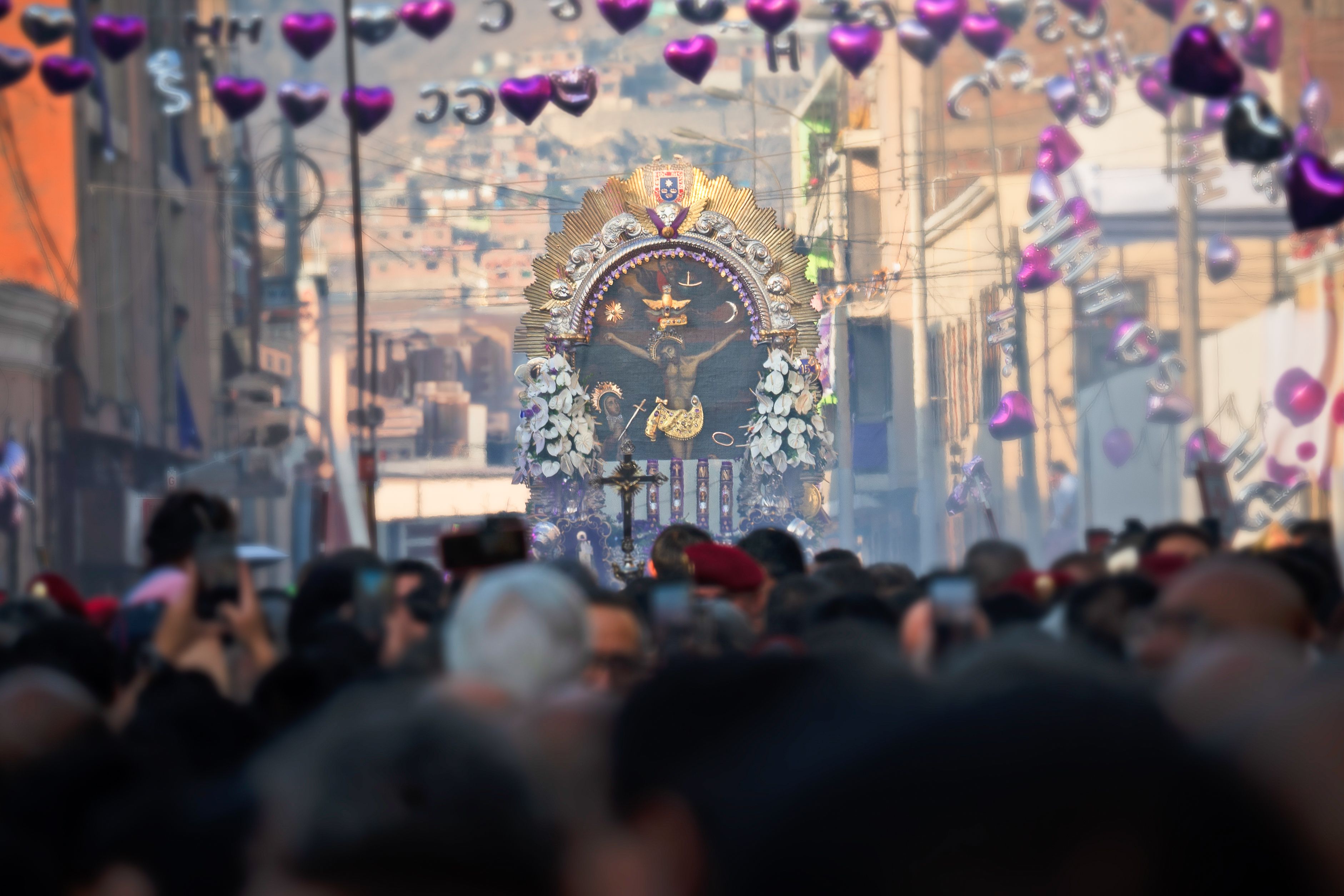
Every October, Peru turns purple. Streets fill with incense smoke, hymns echo off colonial facades, and millions of people — from Lima to Los Angeles — tie purple sashes around their waists in an act of devotion stretching back more than three centuries. This is the Señor de los Milagros, and understanding it means understanding something essential about Peruvian culture.
Why is October called the Purple Month in Peru?
October is called "el mes morado" — the purple month — in Peru because of the Señor de los Milagros processions, during which enormous crowds of devotees dress in purple habits to honor a miraculous image of Christ as it is paraded through Lima's streets. Purple, the color of penitence and devotion, becomes so pervasive across the country throughout October that it defines the entire month visually, spiritually, and socially. No other single tradition shapes Peruvian October culture as completely, touching food, fashion, public life, and personal faith at once.
The purple habit devotees wear traces its origins to the Monastery of Las Nazarenas, where Mother Antonia Lucía del Espíritu Santo established the practice. Today, wearing purple during October is both a religious commitment and a cultural identity marker for millions of Peruvians at home and abroad.
What is the origin of Señor de los Milagros?
The devotion began with a mural painted in the mid-17th century on a wall in Pachacamilla, a district of Lima, by an Afro-Angolan enslaved person named Pedro Dalcón. The image depicted the crucified Christ and, remarkably, survived two major earthquakes — including the catastrophic 1655 tremor — while surrounding structures crumbled. Survivors interpreted the image's endurance as a divine miracle, and popular veneration grew rapidly.
The image, also known as Cristo Moreno or Cristo de Pachacamilla, was housed in the Sanctuary of Las Nazarenas in Lima. Over time, the devotion expanded from a neighborhood gathering into a national and eventually international phenomenon. In 2005, the Holy See and the Archdiocese of Lima formally named Señor de los Milagros the Patron of Peruvians Abroad and Immigrants, and in 2010 it received recognition as Patron of Catholic Spirituality in Peru. The festival has also been declared a Cultural Heritage of Peru.
What happens during the Lima procession?
The Lima procession unfolds across several days in October and is among the largest religious gatherings in the Americas. Devotees carefully mount the image of Señor de los Milagros on an ornate silver litter and carry it through downtown Lima. The route winds past major landmarks including the Presidential Palace and the Metropolitan Cathedral, where official institutions pay formal homage.
Along the way, the air is thick with incense, and participants sing traditional hymns called salves. Flower carriers, penitents walking barefoot, and incense bearers all form distinct roles within the procession's elaborate structure. The event is a living cultural performance in which the entire city participates, from government officials to ordinary families lining the streets.
|
Role in the Procession |
Description |
Attire |
|
Cargadores |
Carry the image on a silver litter |
Purple habit |
|
Sahumadoras |
Carry incense burners |
Purple habit |
|
Flower carriers |
Scatter flower petals along the route |
Purple habit |
|
Penitents |
Walk barefoot as an act of devotion |
Purple habit |
|
Cantoras |
Lead traditional hymns and salves |
Purple habit |
What is turrón de Doña Pepa and why does it matter?
Turrón de Doña Pepa is the sweet most closely associated with Peruvian October traditions, sold at every street corner during the Señor de los Milagros festivities and beloved as a seasonal treat with deep cultural meaning. The confection is a layered nougat made from flour, eggs, anise, and chancaca — a raw cane sugar syrup — topped with colorful candy sprinkles and fruit honey, giving it a festive, jewel-like appearance.
Its origin is linked to Josefa Marmanillo, an Afro-Peruvian cook known as Doña Pepa. According to tradition, she had a paralysis that left her unable to use her arms. After praying fervently to the Señor de los Milagros, she was healed, and in gratitude she created and offered this sweet during the procession. Some food scholars note that the turrón's lattice structure and vivid decoration may symbolically echo the procession itself — its layers representing the penitents, flower carriers, and incense bearers moving through Lima's streets.
This connection between Peruvian culinary traditions and cultural celebration is a pattern across Latin American heritage communities—food is never just sustenance; it is ceremony, memory, and identity in edible form.
How do Peruvian communities in the U.S. celebrate the Purple Month?
Peruvian expatriate communities across the United States observe October's Purple Month through organized masses, processions, and cultural gatherings, most coordinated by Señor de los Milagros brotherhoods established in major cities. In Florida alone, brotherhoods in Miami, Tampa, and Miramar organize annual events that draw thousands of Peruvian Americans and visitors, replicating the devotional structure of the Lima procession with purple-clad participants, incense, and traditional hymns.
These gatherings serve a dual purpose: they are acts of faith and acts of cultural preservation. For Peruvians living far from Lima, October's rituals become a way to transmit tradition to younger generations born in the United States, ensuring that the significance of Peruvian October traditions is not lost across the diaspora. Just as Latin American summer festivals keep communities connected across borders, the Purple Month extends Peru's most important religious celebration far beyond South America.
The Señor de los Milagros was formally recognized as Patron of Peruvians Abroad and Immigrants because of this reality—the devotion travels with the people, taking root in new cities while remaining anchored in Peruvian identity. These U.S.-based events also often incorporate food traditions like turrón de Doña Pepa, sold at community gatherings alongside other Peruvian staples rooted in the country's rich Latin American superfood heritage.
Why does the Purple Month matter beyond Peru's borders?
Señor de los Milagros is a living archive of Peruvian history, Afro-Peruvian contributions, colonial survival, and communal faith that resurfaces every October with remarkable consistency. From the miraculous mural painted by Pedro Dalcón to the turrón crafted by Doña Pepa, the traditions surrounding Peru's Purple Month carry the fingerprints of marginalized communities whose devotion shaped one of the most significant cultural events in the Americas.
For Peruvians in the United States, October becomes an annual reclamation of identity. The purple habit, the hymns, the scent of incense, and the taste of turrón de Doña Pepa create a sensory bridge between Lima and whatever city a Peruvian family now calls home. That continuity — maintained by brotherhoods, families, and communities — is exactly what cultural preservation looks like in practice.
Looking to connect with the Peruvian community near you or discover events happening this October? Explore the Peruvian tribe on United Tribes and find the celebrations, businesses, and stories keeping the Purple Month alive across the U.S.
Frequently Asked Questions
When exactly does the main Señor de los Milagros procession take place in Lima?
The largest processions in Lima take place on October 18th and 19th each year, with additional observances throughout the month. The image is carried through downtown Lima over multiple days, drawing millions of participants and lining the route with institutions paying official homage.
Is wearing purple during October required for all Peruvians?
Wearing purple during October is a voluntary act of devotion rather than a legal or religious requirement. However, the practice is so widespread that it functions as a cultural norm, with many Peruvians — religious and non-religious alike — wearing purple clothing throughout the month as a sign of solidarity and cultural identity.
Who were the key historical figures behind the Señor de los Milagros tradition?
Two Afro-descendant figures are central to the tradition: Pedro Dalcón, the Afro-Angolan enslaved person who originally painted the mural in Pachacamilla, and Josefa Marmanillo (Doña Pepa), the Afro-Peruvian cook whose healing story gave birth to turrón de Doña Pepa. Both figures highlight the celebration's significant Afro-Peruvian roots.
Can non-Catholics or non-Peruvians participate in the procession or celebrations?
Yes, the Señor de los Milagros procession is open to all who wish to join respectfully, regardless of nationality or religion. Many non-Peruvians and non-Catholics participate as observers or cultural supporters, and community events in the United States often welcome the broader public to experience Peruvian culture and traditions firsthand.
Where can I find turrón de Doña Pepa in the United States during October?
Turrón de Doña Pepa is typically available at Peruvian bakeries, Latin American grocery stores, and community events organized by Señor de los Milagros brotherhoods throughout October. Cities with large Peruvian populations — such as Miami, New York, Los Angeles, and Paterson, New Jersey — are the most reliable places to find authentic versions of the sweet.
How did Señor de los Milagros become recognized as the Patron of Peruvians Abroad?
In 2005, the Holy See and the Archdiocese of Lima formally named Señor de los Milagros the Patron of Peruvians Abroad and Immigrants, acknowledging the way the devotion had traveled with Peruvian diaspora communities around the world. This recognition validated what communities had already practiced for decades—carrying their October traditions to new countries and cities far from Lima.
Make United Tribes Your Preferred Source
Add United Tribes on Google to get the latest stories, cultural updates, and community events directly in your Google Search and Top Stories.