

Key Takeaways
- Karwa Chauth 2026 falls on October 29. The festival falls on the fourth day of the waning moon in the Hindu month of Kartik, making it a Thursday this year.
- The nirjala fast lasts roughly 14 to 15 hours. Married Hindu women abstain from both food and water from pre-dawn until the moon rises that evening.

Welcome to United Tribes
Where Indian Culture Comes Alive
Join Your Tribe
Connect with your people
Discover Events
Watch parties & festivals
Find Indian Businesses
Restaurants, markets & more
Earn Crown Credits
Get rewarded for engaging
- Sargi is a pre-dawn meal prepared by the mother-in-law. It typically includes feni, fruits, dry fruits, and sweets, giving fasting women sustenance before sunrise.
- The moon-sighting ritual is the fast's ceremonial centerpiece. Women view the moon through a sieve, offer water, then look at their husband before breaking the fast with his offering.
- The festival is not universally observed across India. Karwa Chauth is rooted in North Indian states like Punjab and Rajasthan, and participation varies widely across households and generations.
Every year, as October settles into its final weeks, households across North India and in Indian communities worldwide turn their attention to one of the season's most recognized festivals. Karwa Chauth 2026 falls on Thursday, October 29 — a day marked by fasting, devotion, ritual, and, for many families, quiet acts of love that stretch from before dawn until moonrise.
What is Karwa Chauth and why is it celebrated?
Karwa Chauth is a one-day festival observed by married Hindu women in parts of North India, during which they fast from sunrise to moonrise to pray for their husbands' health and long life. It falls on the fourth day — Chaturthi — of the waning moon (Krishna Paksha) in the Hindu month of Kartik, placing the 2026 observance on October 29.
The festival's name combines "Karwa," referring to an earthen pot used in ritual offerings, and "Chauth," meaning the fourth lunar day. In Sanskrit, it is sometimes called Karaka Chaturthi. Its origins are rooted in mythology and community practice across northwestern India — stories from texts like the Mahabharata reference Savitri's fierce devotion, while regional folklore tells of Queen Veervati and a woman named Karva whose steadfast love became the foundation of the fast. Agricultural historians also note connections to wheat-sowing seasons in Punjab and Haryana, where women's community solidarity was woven into the calendar's rhythm.
Karwa Chauth is predominantly celebrated in Punjab, Haryana, Himachal Pradesh, Uttar Pradesh, Rajasthan, Madhya Pradesh, and Delhi. It is not a pan-Indian festival — many households across southern, eastern, and even parts of western India do not observe it. Within the states where it is recognized, individual families vary widely in how strictly or elaborately they participate.
What does the Karwa Chauth fast involve from dawn to dusk?
The fast is a nirjala fast—the strictest form of fasting in Hindu tradition —requiring complete abstention from both food and water. Depending on location and the year's lunar calendar, the fast typically runs for 14 to 15 hours.
The day begins well before sunrise with the Sargi, a pre-dawn meal prepared by the mother-in-law for her daughter-in-law. Sargi is more than a practical meal — it is a gesture of care and blessing. A traditional Sargi spread includes feni (sweet vermicelli), seasonal fruits, dry fruits, sweets, and sometimes a small gift. Women eat before sunrise and then begin the fast, which they maintain through the full day without food or water.
The table below outlines the key stages of a traditional Karwa Chauth observance:
|
Stage |
Time |
Key Practice |
|
Sargi meal |
Pre-dawn |
Mother-in-law prepares food for daughter-in-law |
|
Fast begins |
Sunrise |
No food or water until moonrise |
|
Afternoon preparations |
Midday–evening |
Women dress in bridal finery, apply henna |
|
Puja ceremony |
Evening |
Group worship, Karwa passing, Vrat Katha recitation |
|
Moon sighting |
Moonrise |
Viewing the moon through a sieve, offering water |
|
Fast broken |
Moonrise |
Husband offers first sip of water or a sweet |
How is the evening puja ceremony performed?
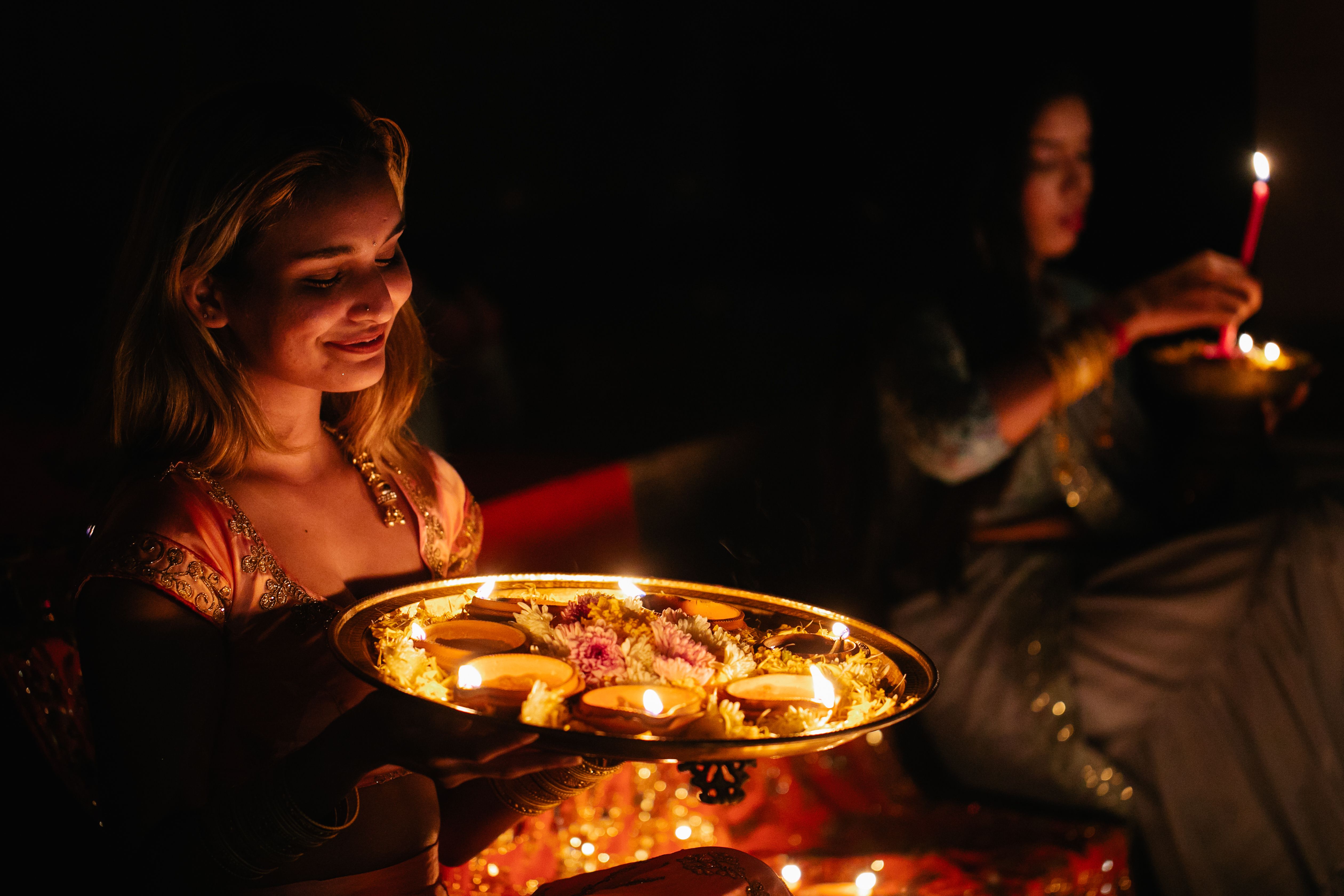
The evening puja is the emotional and spiritual heart of Karwa Chauth rituals. Women gather — traditionally in groups, often in a circle — dressed in red or bridal colors, adorned with jewelry and henna, holding decorated thalis or Karwa pots.
During the puja, they recite or listen to the Vrat Katha. These devotional stories of Veervati, Savitri, or KarvaMatat anchor the fast in mythology and reinforce its purpose. Karwas or thalis are passed around the circle in a communal act of shared ritual, and lamps are lit as prayers are offered.
The moon-sighting ritual closes the evening. When the moon rises, women view it through a chhanni — a traditional sieve — and offer water (Arghya) to the moon. They then look at their husband through the same sieve. The husband offers his wife the first sip of water or a sweet, formally breaking the fast. This exchange—intimate and symbolic—is often described by participants as the emotional peak of the day.
How are modern couples reinterpreting Karwa Chauth?
Contemporary couples, particularly in urban India, are reshaping how Indian marriage traditions like Karwa Chauth are observed. Many husbands now fast alongside their wives as an act of solidarity and mutual devotion, moving away from the original tradition's unidirectional structure.
Others take on practical support roles — arranging the puja setup, sourcing Sargi ingredients, tracking moonrise times, or simply staying close through the long hours of the fast. Some unmarried women participate as an expression of romantic aspiration or friendship, widening the festival's emotional vocabulary beyond marriage.
These adaptations do not mean the tradition is weakening. For many families, they represent an evolution—a way to keep Indian festivals meaningful across generations with different values and expectations.
How do Indian diaspora communities observe Karwa Chauth abroad?
For Indian immigrants living abroad, Karwa Chauth requires creative adaptation. Community gatherings in the U.S., UK, and Canada bring women together for shared puja ceremonies, recreating the circle of worship that might otherwise be impossible far from extended family.
Practical solutions fill the gaps that distance creates. Family in India sends sargi boxes by courier — or mothers-in-law who have emigrated assemble them locally. Women calculate moonrise times for their specific city rather than their hometown. Improvised sieves stand in for traditional chhanni when supplies are not available. The Vrat Katha is streamed online or played via apps, allowing women to follow the ritual even in isolation.
What the diaspora experience reveals is that the festival's emotional core — devotion, community, shared ritual — travels remarkably well. Many Indian-American women describe explaining the fast to non-Indian colleagues or neighbors as an opportunity to share something personal and culturally meaningful, a moment of visibility that connects identity to practice. This reflects the broader experience of blending cultural values across generations in an American context.
Do all Indian households celebrate Karwa Chauth?
Karwa Chauth is not a universal Indian festival — participation is concentrated in specific North Indian states and varies significantly across regions, castes, and individual families. Many married Hindu women in South India, East India, and large parts of western India do not observe the fast.
Even within North India, observance differs. Some households follow every ritual in detail; others mark the day with a simple evening prayer and meal. Generational shifts mean that younger women may choose not to fast, or may observe it more casually, while older women in the same family maintain strict nirjala tradition. This diversity is part of the festival's living character — like many celebrations explored in Indian festivals of light beyond Diwali, Karwa Chauth means different things to different communities, and that variation is worth acknowledging honestly.
What does Karwa Chauth reveal about devotion across distances?
Karwa Chauth 2026 arrives on October 29, carrying centuries of mythology, community practice, and personal meaning. From the quiet pre-dawn Sargi to the moment the moon clears the horizon, the festival moves through rituals that are at once deeply structured and deeply intimate — a day shaped by tradition, but lived differently in every household that observes it.
For Indian diaspora communities in the United States, the festival is also a statement of identity. Sourcing Sargi ingredients locally, calculating moonrise for a new time zone, gathering with other families to share the Vrat Katha — these small acts of adaptation are how cultural memory is sustained across generations and geography. Karwa Chauth, observed or not, remains a visible marker of North Indian heritage and the continuing relevance of ancient traditions in modern lives.
Looking to connect with other members of the Indian-American community who celebrate festivals like this one — or to find businesses and events that honor these traditions? Explore the Indian community on United Tribes and discover what's happening near you.
Frequently Asked Questions
What time does the Karwa Chauth fast begin and end in 2026?
The fast begins before sunrise on October 29, 2026, following the pre-dawn Sargi meal, and ends at moonrise that evening. The exact moonrise time varies by location — women fasting outside India should check local moonrise times for their city to know when to begin the evening rituals.
Can women with health conditions observe the Karwa Chauth fast?
Women with medical conditions, pregnancy, or health concerns are generally advised by religious authorities and doctors to modify or skip the nirjala fast. In many families, a partial fast — avoiding certain foods but drinking water — is considered an acceptable alternative that preserves the spirit of devotion without risk.
What is the significance of looking at the husband through a sieve?
Viewing the moon and then the husband through a chhanni (sieve) is a symbolic act rooted in filtering perception—seeing with clarity, protection, and auspiciousness. The sieve's mesh is associated with filtering out ill fortune, and the husband's offering of water formalizes the fast's reciprocal nature.
What should a Sargi box typically include for Karwa Chauth?
A traditional Sargi box includes feni (sweet vermicelli), seasonal fruits, dry fruits such as almonds and cashews, sweets, coconut, and sometimes a small gift or piece of clothing. The contents are meant to provide energy for the long fast ahead and are chosen by the mother-in-law as a blessing for her daughter-in-law.
Do unmarried women observe Karwa Chauth, and is that traditional?
Unmarried women observing Karwa Chauth is a relatively modern practice, particularly popular in urban areas. Some fast for a future husband or as a mark of romantic commitment, while others participate alongside married friends or family members. This practice has no strong traditional roots but reflects how the festival's cultural meaning has broadened over time.
How is Karwa Chauth different from other North Indian fasting observances?
Karwa Chauth differs from other Hindu fasts because it is tied to a wife's prayer for her husband's longevity, uses a unique moon-sighting ritual with a sieve, and involves communal female gatherings centered on the Vrat Katha. Other fasts like Teej or Ekadashi have different mythological origins, ritual structures, and regional distributions across India.
Make United Tribes Your Preferred Source
Add United Tribes on Google to get the latest stories, cultural updates, and community events directly in your Google Search and Top Stories.