

Key Takeaways
- Khatamkari is micro-marquetry at its most precise. A single square inch of khatam work may contain more than 400 miniature pieces of wood, bone, and metal assembled by hand.
- Shiraz and Isfahan are the craft's historic heartlands. Khatamkari originated in Shiraz and flourished during the Safavid period, when Isfahan became its most celebrated center.

Welcome to United Tribes
Where Persian Culture Comes Alive
Join Your Tribe
Connect with your people
Discover Events
Watch parties & festivals
Find Persian Businesses
Restaurants, markets & more
Earn Crown Credits
Get rewarded for engaging
- The Safavid era elevated khatamkari to royal status. During the 16th and 17th centuries, khatam was considered a refined art form worthy of princes alongside music and painting.
- The craft nearly vanished before a 20th-century revival. By around 1920, only a handful of masters remained; a subsequent revival under Reza Shah rebuilt the industry, especially in Isfahan.
- Khatamkari survives today in workshops and cultural institutions. Contemporary artisans in Shiraz, Isfahan, and Tehran continue producing khatam pieces, preserving this intricate Iranian handicraft for future generations.
Few crafts anywhere in the world demand the patience that Persian khatamkari requires. Thousands of slivers of wood, camel bone, and brass, each no wider than a matchstick, are coaxed into patterns so exact that the finished surface looks almost machine-made. The reality is entirely human — and entirely remarkable.
What is Persian khatamkari and why does it matter?
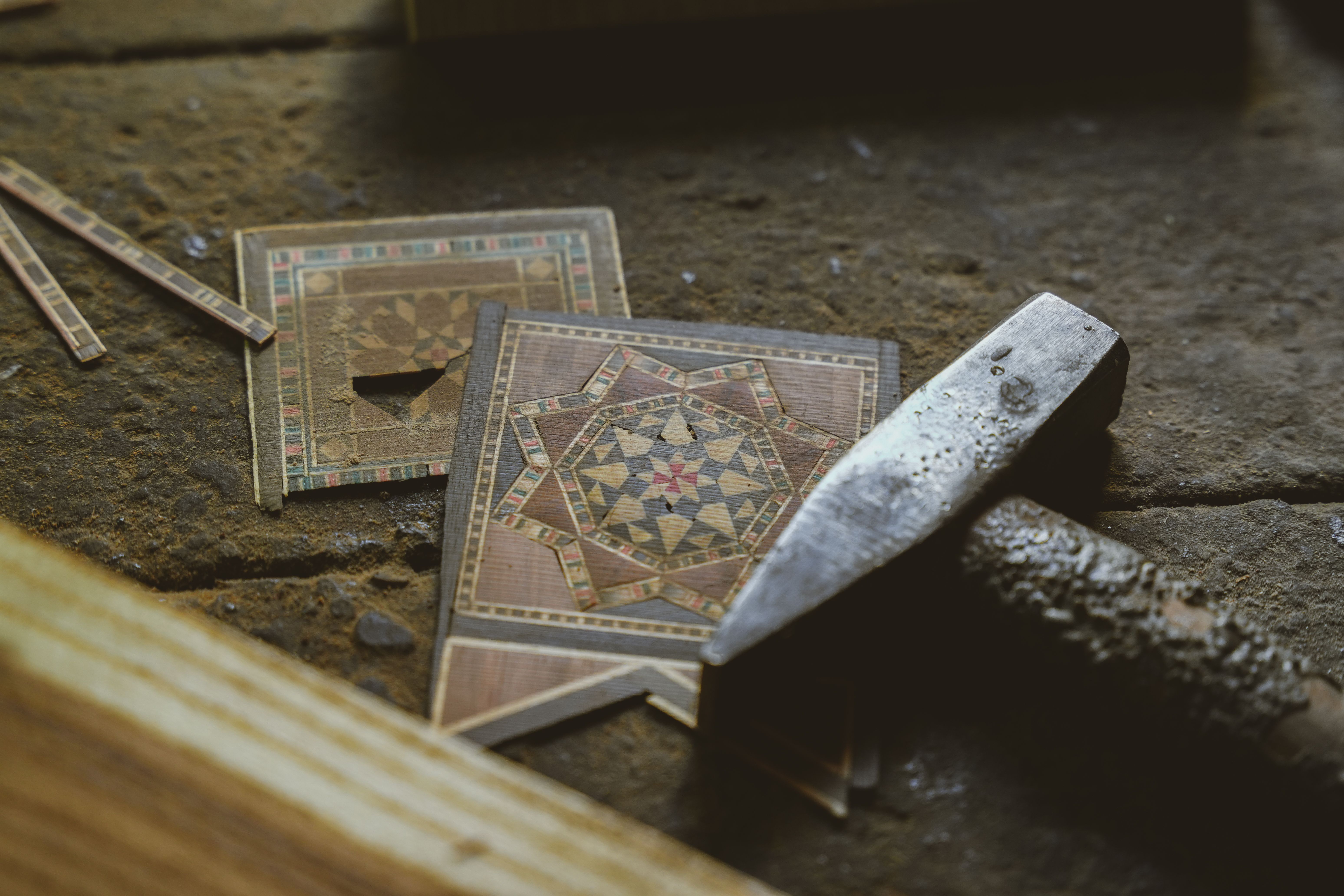
Khatamkari is the ancient Persian art of geometric micro-marquetry, in which artisans assemble slender triangular rods of contrasting materials into repeating star and polygon patterns, slice them into wafer-thin sections, and apply those sections to wooden surfaces. The term "khatam" literally means incrustation, while "khatam-kari" describes the full practice of that inlay work. As one of Iran's most technically demanding traditional crafts, it represents a living bridge between mathematical precision and artistic beauty that has endured for centuries.
The materials used — ebony, teak, jujube, rosewood, camel bone, and brass — are chosen as much for their contrasting colors as for their workability. Once assembled into a patterned bundle and sliced thin, each section reveals a kaleidoscopic geometry that is immediately recognizable as Persian geometric art. The completed surface is then sealed with lacquer or oil to protect its delicate mosaic and give it the luminous finish collectors prize.
Where Did Khatamkari Originate And How Did It Spread?
Khatamkari originated in Shiraz, which remains home to some of the oldest surviving pieces of this Iranian marquetry tradition. From Shiraz, the craft traveled north to Isfahan, where it matured into a court art during the Safavid dynasty of the 16th and 17th centuries.
The Safavid era was the golden age of Persian traditional crafts broadly, and khatamkari was no exception. Princes studied the art alongside music and painting, signaling how seriously the royal court regarded it. Isfahan's workshops refined techniques that Shirazi masters had developed, and the city became so identified with the craft that khatamkari and Isfahan were almost synonymous terms by the height of the empire.
Khatam Pieces and Artisan Specialties
Creating a khatam piece follows a precise sequence of steps that can take weeks or months, depending on the object's size and complexity.
1. Rod preparation: Artisans cut materials — wood species, bone, and metal — into long, slender triangular rods of uniform thickness.
2. Bundle assembly: The rods are grouped and glued into larger patterned bundles, typically forming star-shaped or hexagonal repeat motifs.
3. Slicing: The hardened bundle is sliced crosswise into extremely thin sections, each revealing the full geometric pattern.
4. Application: Sections are fitted together and adhered to the prepared wooden base, covering the surface without gaps.
5. Finishing: The object is sanded smooth and sealed with lacquer or natural oil, locking the mosaic in place and producing the characteristic sheen.
The scale of this work is difficult to overstate. A single square inch of fine khatam can contain more than 400 individual pieces. Some of the most refined examples approach nearly 200 components per cubic centimeter, making Persian khatamkari among the most labor-intensive of all Iranian handicrafts.
|
Material |
Type |
Role in the Pattern |
|
Ebony |
Wood |
Dark tonal contrast and structure |
|
Teak |
Wood |
Warm mid-tone fill |
|
Jujube |
Wood |
Light-colored accent pieces |
|
Camel bone |
Bone |
White highlights and fine detail |
|
Brass |
Metal |
Metallic shimmer within geometric lines |
Traditional Khatam Motifs and Decors
Khatamkari appears on almost any wooden surface that can carry its intricate surface, from small personal objects to large furnishings. Decorative boxes and frames are the most common items for collectors, but the craft's range extends far beyond those familiar forms.
Traditional objects decorated with Persian khatamkari include Quran stands (rehals), musical instruments, mirrors, candlesticks, vases, coin boxes, pen cases, and photo frames. Larger furniture pieces — tables, cabinets, and chairs — have also been finished with khatam veneers, turning functional objects into statements of cultural artistry. This versatility explains why the craft persisted across so many social contexts, from royal palaces to family homes.
Khatamkari Decline and Resurgence
Yes — by the late 19th and early 20th centuries, khatamkari had contracted sharply, with only a small number of masters still practicing around 1920. The disruptions of that era left the craft dangerously close to disappearing entirely from Iran's artistic landscape.
The revival came through deliberate institutional effort. Under Reza Shah, the Iranian government supported craft education, and a Shirazi master named Golriz relocated to Isfahan, where he taught at the Honarestān for decades. His influence helped rebuild a new generation of practitioners. By the 1950s, Isfahan had roughly 40 active workshops; by the 1970s that number had grown to more than 80, employing hundreds of artisans. Before 1979, the industry was estimated to support around 50 masters and 300 skilled workers — a remarkable recovery from near-extinction just decades earlier.
The story of khatamkari's revival mirrors patterns seen across Persian traditional crafts. Just as Persian carpet weaving has required institutional and community support to survive modernization, khatamkari depended on dedicated teachers passing knowledge directly to students before it could flourish again.
Khatamkari and its Contemporary Adaptations
Today khatamkari continues in workshops across Shiraz, Isfahan, and Tehran, sustained by a combination of private studios, cultural heritage institutions, and a growing international appreciation for Iranian handicrafts. Master artisans still traditionally train apprentices, emphasizing the hand-eye coordination and patience the craft demands before any formal design work begins.
Iranian-American communities have also played a quiet but meaningful role in preserving this art form outside Iran. Collectors seek authentic khatam pieces as both heirlooms and cultural symbols, while some diaspora artisans have introduced the geometric vocabulary of khatamkari to new media and contexts. This resonates with a broader pattern of Iranian cultural expression in the United States, where traditions from Persian miniature painting to Persian jewelry craft find new audiences without losing their roots.
The geometric patterns at the heart of khatamkari also speak to a mathematical tradition deeply embedded in Persian culture — the same impulse that produced the tile work of great mosques and the compositions studied in Persian influence on American art. When an artisan fits the thousandth triangular sliver into place, they are continuing a conversation between craft and geometry that began long before the Safavid court elevated it to an imperial art.
Khatamkari and its Place in The Modern World
Khatamkari endures because it is irreplaceable. No machine can replicate the slight irregularities and cumulative decisions embedded in a hand-assembled bundle of rods, and no shortcut can substitute for the years of practice required to slice, fit, and finish a surface at that scale. From its origins in Shiraz through its Safavid golden age in Isfahan to its hard-won 20th-century revival, the craft has proven that precision and patience are their own form of cultural argument.
For Iranian and Iranian-American communities, khatam pieces are more than decorative objects. A rehal, a jewelry box, or a framed mirror covered in khatamkari carries the geometry of a civilization — one that valued beauty as a serious discipline. Preserving this art means preserving that sensibility, and sharing it with wider audiences means extending one of the most technically remarkable traditions in Persian geometric art history.
Connecting with Iranian craftspeople, collectors, and cultural storytellers who keep this tradition alive is easier when there is a dedicated space for it — explore the Iranian community on United Tribes and discover the artisans and businesses bringing khatamkari and other Persian traditional crafts into contemporary life.
Frequently Asked Questions
Is khatamkari the same as marquetry found in European furniture traditions?
Khatamkari shares the basic principle of inlaid surface decoration with European marquetry, but the two traditions are distinct. Persian khatamkari uses triangular rods assembled into bundles and sliced crosswise to create geometric repeat patterns. Meanwhile, European marquetry typically cuts individual veneer pieces to fit a pre-designed image or motif.
How long does it take to complete a single khatam piece?
The time required depends entirely on the size and complexity of the object. A small decorative box might take days of careful work. Meanwhile, a large piece of furniture or a musical instrument can take weeks or even months, since fine khatam work may involve hundreds of individual components per square inch.
Can khatamkari be learned outside of Iran?
Yes, khatamkari can be studied outside Iran through specialist craft workshops, diaspora community programs, and some Iranian cultural centers in the United States and Europe. However, the most comprehensive training still comes through direct apprenticeship with a master craftsperson, ideally in Shiraz, Isfahan, or Tehran, where the tradition is strongest.
What makes Isfahan particularly important to khatamkari history?
Isfahan became the premier center of khatamkari during the Safavid dynasty, when royal patronage elevated the craft to a courtly art. The city later led the craft's 20th-century revival after master Golriz relocated from Shiraz to teach at Isfahan's Honarestān, helping rebuild a generation of practitioners when the tradition was close to dying out.
Are there different regional styles of khatamkari within Iran?
Shiraz and Isfahan represent the two main regional traditions, with Shiraz credited as the birthplace and Isfahan as the city that refined and institutionalized the craft. While both share the same fundamental geometric vocabulary, the workshops of each city developed their own finishing preferences, material combinations, and design emphases over generations of practice.
How should a khatam piece be cared for to preserve its surface?
Khatamkari surfaces should be kept away from extreme humidity, direct sunlight, and harsh cleaning products, all of which can damage the lacquer or oil finish and cause the tiny inlaid pieces to warp or lift. Gently dust with a soft, dry cloth and keep the object in a stable indoor environment; this is generally enough to maintain its condition over the long term.
Make United Tribes Your Preferred Source
Add United Tribes on Google to get the latest stories, cultural updates, and community events directly in your Google Search and Top Stories.


