
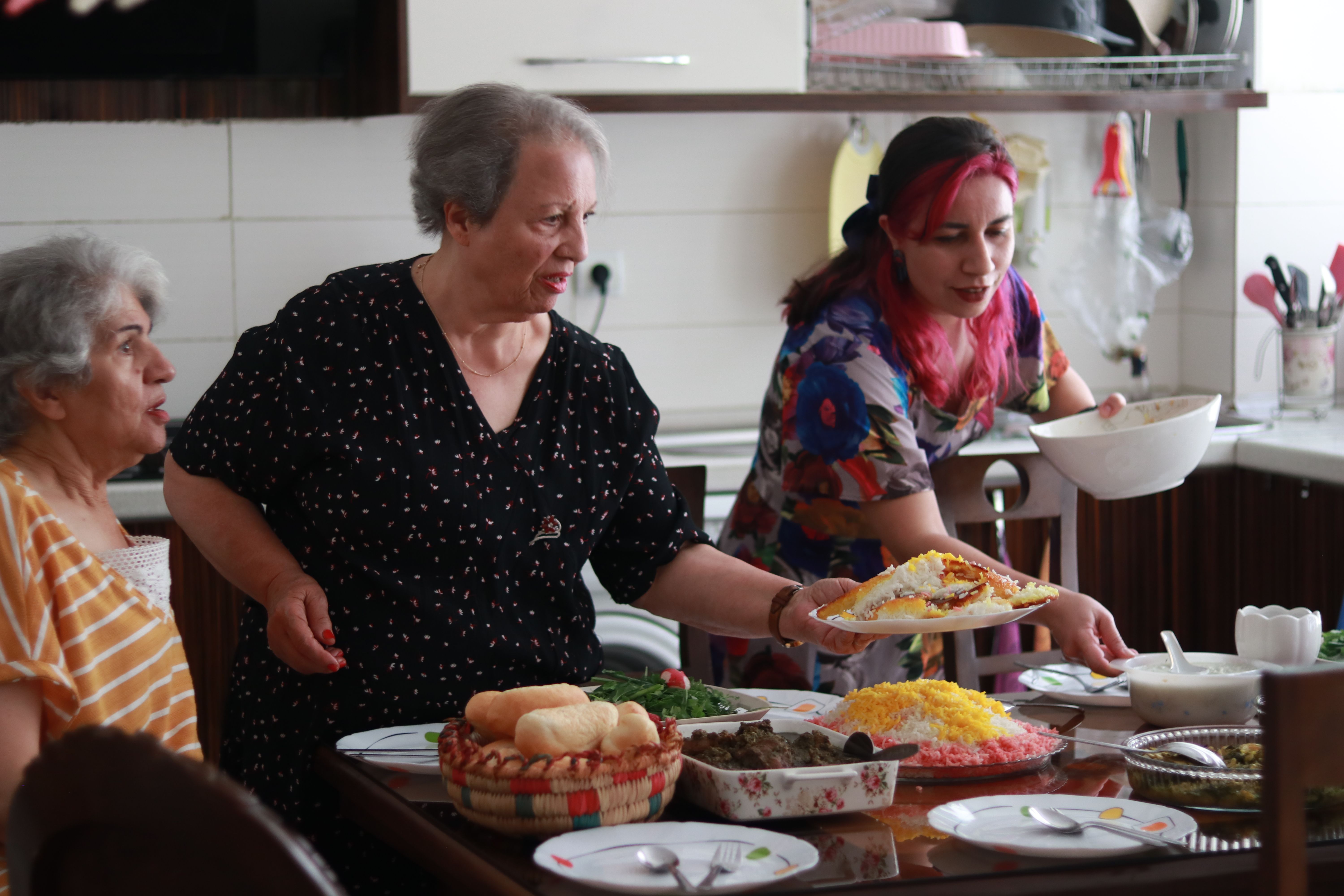

You've just finished a generous plate of ghormeh sabzi, your host is already reaching for the serving spoon, and before you can exhale, there's more on your plate. If you've ever sat at a Persian dinner table, you know this moment. These dining experiences are one of the most sincere expressions of care in Iranian family traditions. Understanding why it happens reveals something beautiful about how Persian culture treats guests.
Food Is How Persian Hosts Say "I Love You"
In Persian households, feeding someone well is an act of emotional investment. A host who spent hours layering rice with a crisp tahdig crust, slow-cooking a stew, or arranging a spread of fresh herbs and flatbread didn't do so casually. Every dish carries labor and intention. Offering more food is the natural extension of that effort; it says, *I made this for you, and I want you to have enough.*

Welcome to United Tribes
Where Persian Culture Comes Alive
Join Your Tribe
Connect with your people
Discover Events
Watch parties & festivals
Find Persian Businesses
Restaurants, markets & more
Earn Crown Credits
Get rewarded for engaging
Persian food culture places enormous weight on abundance. A table that looks full signals prosperity, care, and respect toward the guest. A table that runs low feels like a failure of hospitality, regardless of how much everyone ate. This is why your host will almost certainly offer seconds before you've finished your first serving.
Where Taarof Ends and Genuine Generosity Begins
It would be easy to explain repeated food offers purely in terms of taarof, the Iranian social code of ritualized politeness. And taarof does play a role: a host may offer more out of social obligation, and a guest is expected to decline once or twice before accepting. This back-and-forth is real and culturally meaningful.
But the food served at a Persian dinner table often goes beyond the ceremonial structure of taarof. The distinction matters. Mehrbani, the concept of genuine warmth and benevolence, is closely associated with taarof in Iranian culture. Where taarof is about form, mehrbani is about feeling. The repeated food offers you experience at a Persian table are usually a blend of both.
The Guest Is Sacred in Persian Hosting Customs
Persian hosting customs are built on a foundational belief: the guest is a gift. Traditional Iranian culture holds that a visitor brings blessings into a home, and the host's role is to honor that. This shapes everything from how quickly tea appears after arrival to how insistently food is offered throughout the meal.
Persian hospitality at home is about ensuring the guest feels welcome and cared for, leaving feeling full in every sense of the word. Running out of food, or allowing a guest to sit with an empty plate, would genuinely distress a Persian host. Offering more is as much a protective instinct as it is an act of generosity.
How to Accept or Decline Without Offending Anyone
Navigating the offer-decline cycle gracefully is part of being a good guest in Iranian culture. Here's how it generally works:
1. First offer — Decline politely. This is expected and shows you aren't being greedy.
2. Second offer — You may decline again, or accept. Either is acceptable.
3. Third or persistent offer — Accept something, even a small portion. Continuing to refuse can come across as dismissive to a host who genuinely wants you to eat.
4. When you're truly full — A gentle, warm phrase acknowledging the food's quality softens any refusal. Saying the meal was wonderful goes a long way.
The goal is to show that the host's effort was valued. Even accepting a small second serving communicates that the food was good enough to want more. That matters enormously to someone who spent their day cooking.
The Table Itself Tells a Story
Iranian dining etiquette also begins with how the table is set. A traditional Persian spread often includes multiple dishes served simultaneously rather than in courses. This means abundance is visible from the moment you sit down. Stews, rice, herbs, pickles, yogurt, and bread appear together, creating a landscape of options.
This simultaneous spread is intentional. It reflects a cultural philosophy that a guest should never want for anything — every flavor, texture, and preference should be accounted for. Persian dishes carry deep communal meaning, and the variety on the table is an expression of that shared identity.
What Being a Good Guest Looks Like
Iranian family traditions around hospitality are a two-way relationship. The host gives generously; the guest receives graciously. Being a good guest in Persian culture means showing appreciation openly, not rushing the meal, and allowing the host to feel that their effort landed. Complimenting specific dishes, asking about recipes, or simply sitting and enjoying the company without distraction are all ways guests honor the hospitality extended to them.
Accepting food is one of the clearest ways to participate in this exchange. It closes the loop of generosity — the host offers, the guest receives, and both leave the table feeling the connection was real.
The Plate That Keeps Giving
Persian hospitality at the dinner table is less about food volume and more about emotional language. Every offer of a second serving, every insistence that you try just a little more, is a sentence in a conversation that says: *you matter here, and I want you to feel that.* The overlap between taarof's social rituals and mehrbani's genuine warmth creates a dining experience unlike any other, one where the table itself is an act of love.
For Persian-Americans navigating life between two cultures, these traditions carry weight. Keeping them alive in a diaspora context is its own form of preservation, a way of honoring family, memory, and identity through something as everyday as dinner.
Head to the United Tribes community hub to browse Iranian-owned restaurants, cultural events, and stories from the Persian-American community across the U.S.
Make United Tribes Your Preferred Source
Add United Tribes on Google to get the latest stories, cultural updates, and community events directly in your Google Search and Top Stories.


